Quick Answer
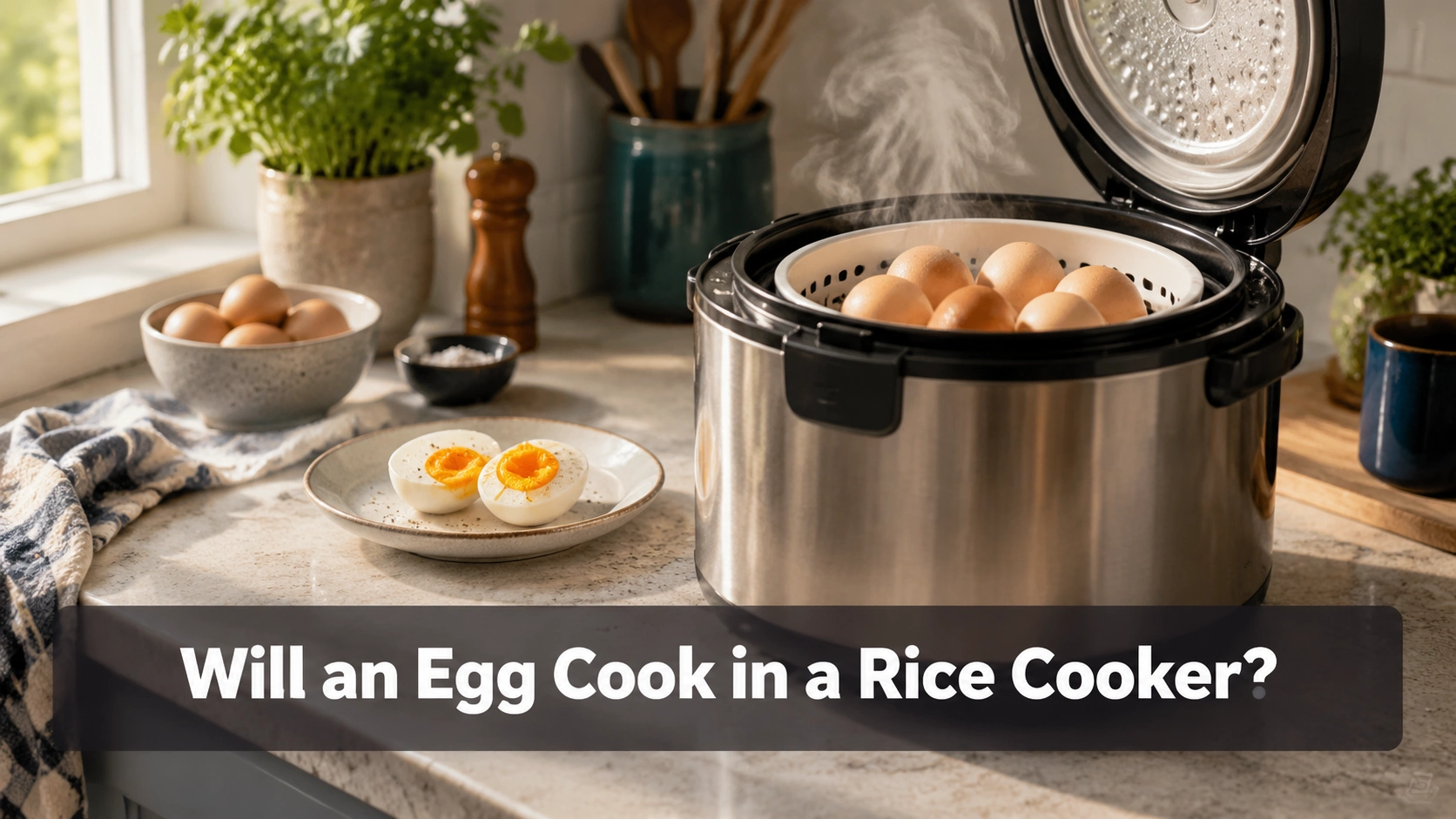
Yes, an egg can cook in a rice cooker when the cooker produces enough heat and steam, but the result depends on the model and cooking method. You can steam eggs in the basket or cook cracked eggs as part of a rice-cooker dish, but you should verify doneness rather than relying on the rice cooker’s timer alone. For food safety, eggs should reach 160°F (71°C); see the USDA egg safety guidance.
What to expect
- Yes, it works: Steam from a rice cooker can cook shell eggs much like a steamer.
- Use the basket: A steaming tray is usually the cleanest way to cook eggs.
- Timing varies: Rice cookers differ in heating power, capacity, and control systems.
- Check doneness: Whites and yolks should be firm, or the egg should reach 160°F when measured appropriately.
- Handle steam carefully: Opening the lid releases hot steam that can cause burns.
I’ve used rice cookers for more than rice, and eggs are one of the easiest foods to experiment with. The important detail is that a rice cooker isn’t automatically an egg cooker, so its heating cycle may behave differently from a dedicated appliance.
In this guide, I’ll explain when a rice cooker can cook eggs, the easiest methods to try, how the results compare with an egg cooker, and what mistakes can leave you with undercooked or overcooked eggs.
In This Guide
Can an egg cook in a rice cooker?
Yes, a rice cooker can cook an egg, especially when you use steam. The cooker heats water, produces hot steam, and traps that heat inside the covered cooking chamber.
A shell egg placed above the water can gradually cook from that steam. The same basic principle is used when eggs are steamed in a conventional pot or electric steamer.
What makes it possible?
A rice cooker has a heating plate or heating system underneath its inner cooking bowl. When water heats, it transfers energy into the surrounding air and produces steam.
Steam cooking means using hot water vapor to transfer heat to food. With eggs, that heat gradually firms the egg white and yolk.
- Water: Provides the moisture needed to generate steam.
- Heat: Raises the water temperature and creates the cooking environment.
- Lid: Holds hot steam around the food.
- Steaming tray: Keeps eggs above the water when the rice cooker includes one.
The catch is that rice cookers aren’t designed primarily around egg cooking. Some models switch from cooking to warming automatically, while others use digital programs with different heating patterns.
That means two rice cookers can produce different egg-cooking results. The appliance’s capacity, heating system, water level, lid design, and program can all affect the process.
Section Takeaway: A rice cooker can cook eggs, but it works best when you treat it as a small steamer rather than assuming its rice cycle guarantees perfect eggs.
How do you cook eggs in a rice cooker?
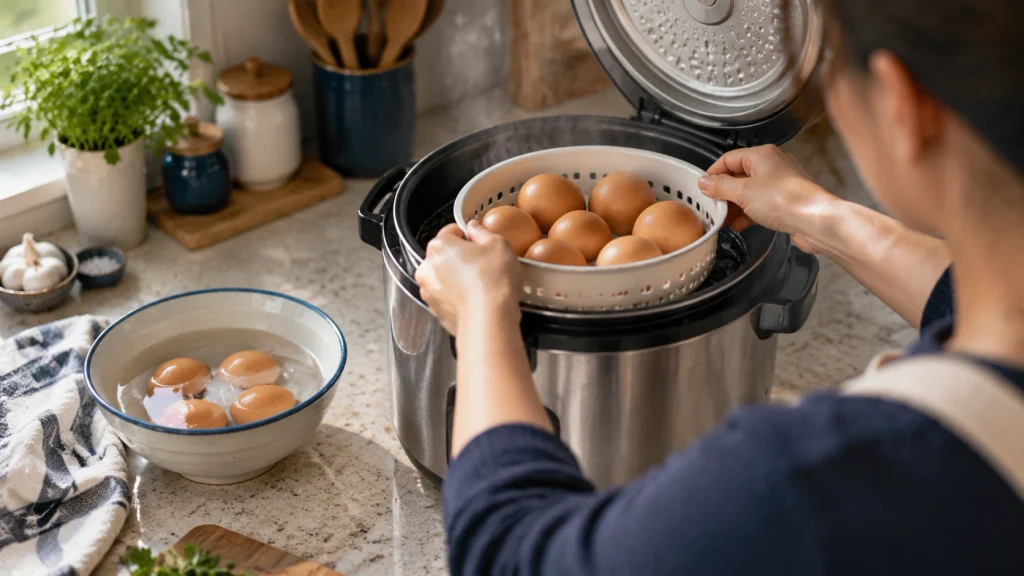
The simplest method is steaming whole eggs in the shell. If your rice cooker has a steaming basket or rack, place the eggs above the water instead of directly on the heating plate.
Method 1: Steam whole eggs
Start with clean, uncracked eggs and enough water to generate steam according to your rice cooker’s instructions. Avoid filling the cooker beyond its recommended level.
- Add water: Put the recommended amount of water into the inner bowl.
- Position the eggs: Place the eggs in the steaming basket or rack.
- Close the lid: Keep the lid closed so steam stays inside.
- Start cooking: Use the cooker’s steam or cook function if available.
- Check doneness: Remove one egg carefully and check the result before serving the whole batch.
- Cool the eggs: Transfer cooked eggs to cool water if you want to stop carryover cooking and make peeling easier.
The exact cooking time isn’t universal. Egg size, starting temperature, water volume, cooker design, and the number of eggs can all change how quickly the center heats.
Method 2: Cook eggs with rice
You can also cook eggs as part of a rice-based meal, depending on the recipe. For example, beaten egg can be incorporated into a cooked rice dish where the rice cooker is specifically being used to cook the complete recipe.
This method requires more attention because the egg is mixed with other ingredients. The center of the finished dish should reach a safe temperature before you eat it.
The USDA recommends cooking eggs to 160°F (71.1°C), and egg dishes should be checked in the center because cooking can be uneven. :contentReference[oaicite:0]{index=0}
Should you put raw eggs directly on the heating plate?
I wouldn’t recommend putting shell eggs directly on a bare heating plate unless the manufacturer’s instructions specifically allow that setup. Direct contact can create hot spots and makes cleanup unnecessarily difficult if an egg cracks.
Using a steaming rack is a cleaner and more controlled approach. It also keeps the eggs away from the heating surface and any rice residue left in the bowl.
Section Takeaway: For whole eggs, steaming is the most practical rice-cooker method. Use the manufacturer’s instructions whenever your model provides a dedicated steam function or tray.
How long do eggs take to cook in a rice cooker?
There isn’t one reliable cooking time for every rice cooker. A small countertop rice cooker and a larger programmable model may heat and cycle differently.
For that reason, I prefer using a test egg rather than treating a recipe’s time as an absolute rule. Once you learn how your cooker behaves, you can repeat the same setup more confidently.
What affects cooking time?
- Egg size: Larger eggs contain more food to heat through.
- Starting temperature: Refrigerated eggs need more heating than eggs already near room temperature.
- Water volume: More water can change how long the cooker produces steam.
- Egg quantity: A crowded basket can change steam circulation.
- Cooker design: Heating elements, sensors, lids, and programs vary between models.
- Altitude: Water boils at a lower temperature at higher elevations, which can make hard-cooking eggs take longer. :contentReference[oaicite:1]{index=1}
If you want firm hard-cooked eggs, check the first batch carefully. Cut one open after cooking and look at the center rather than assuming the timer has done the job.
For food safety, don’t serve eggs that remain visibly undercooked when you are aiming for fully cooked eggs. USDA guidance says eggs should be thoroughly cooked, with whites and yolks firm. :contentReference[oaicite:2]{index=2}
| Factor | What changes | What to do |
|---|---|---|
| Egg temperature | Cold eggs start farther from cooking temperature. | Expect the process to vary slightly. |
| Egg size | Larger eggs take longer to heat through. | Use the same size eggs for repeatable results. |
| Steam circulation | Crowding can change how evenly eggs heat. | Leave room around eggs when possible. |
| Doneness target | Soft, medium, and firm eggs require different results. | Test one egg before serving the batch. |
| Food safety | Eggs need adequate internal heating. | Use 160°F (71.1°C) as the USDA benchmark for eggs. |
Section Takeaway: Don’t copy a cooking time blindly. Your rice cooker and egg size determine the actual result, so verify the first batch and adjust from there.
Is a rice cooker as good as an egg cooker?
A rice cooker can cook eggs successfully, but a dedicated egg cooker is usually more convenient when eggs are a frequent part of your breakfast routine. The dedicated appliance is designed around egg preparation rather than rice cooking.
For occasional eggs, a rice cooker can save counter space because you’re using equipment you already own. For frequent batches, the dedicated appliance may offer more predictable controls and egg-specific accessories.
| Feature | Rice Cooker | Dedicated Egg Cooker |
|---|---|---|
| Primary purpose | Rice and general cooking functions | Egg cooking |
| Steam capability | Depends on model | Commonly designed around steaming eggs |
| Egg-specific controls | Usually limited or absent | Often included |
| Other uses | Rice, grains, steaming, and recipes depending on model | Primarily eggs |
| Best for | People who already own one | Frequent egg preparation |
When does a rice cooker make more sense?
If you’re already making rice, adding eggs to the cooking process can be convenient. A steaming tray can let you prepare another component without turning on a second appliance.
It’s also useful in small kitchens where every appliance takes up valuable counter space. One multifunctional cooker can cover several everyday tasks.
When is an egg cooker better?
If you regularly make hard-cooked, medium, or soft eggs, an egg cooker can simplify the routine. Dedicated controls and accessories can make repeat batches easier.
The biggest advantage isn’t necessarily cooking power. It’s having a cooking system designed specifically around eggs.
Section Takeaway: A rice cooker is a practical multipurpose option, while a dedicated egg cooker makes more sense for frequent egg preparation and repeatability.
What mistakes should you avoid when cooking eggs in a rice cooker?
Most failed rice-cooker eggs come from using the wrong setup rather than from the basic idea being impossible. A few simple precautions make the process cleaner and more predictable.
Don’t use too little water
Steam cooking requires enough water to generate steam throughout the cooking cycle. If the water evaporates too quickly, the cooker may stop heating or the eggs may cook unevenly.
Follow the water guidance in your rice cooker manual instead of guessing. Different bowls and programs can require different amounts.
Don’t overload the steaming tray
Putting too many eggs together can restrict steam circulation. Leave reasonable space between them when the tray design allows it.
A smaller batch is also easier to troubleshoot. You can adjust the process before committing a dozen eggs to an unfamiliar cooking cycle.
Don’t open the lid repeatedly
Every time you lift the lid, hot steam escapes. That reduces the heat around the eggs and can extend cooking time.
Steam can also burn your hands or face. Lift the lid away from yourself and keep your hands out of the escaping steam.
Don’t assume the rice setting equals an egg setting
A rice program is designed around rice and water, not necessarily around the doneness of eggs. The cooker may switch to warm mode before the eggs reach the texture you want.
If your model has a steam setting, that is generally a more logical choice for steaming eggs. Always follow the appliance’s manual when it specifies a particular function.
Don’t ignore damaged eggs
Cracked eggs can leak into the steaming tray and create a difficult cleanup problem. Start with clean, intact shells whenever possible.
USDA guidance also recommends avoiding cracked eggs when purchasing them and keeping egg-contact surfaces clean. :contentReference[oaicite:3]{index=3}
Pro tip: Never bypass a rice cooker’s thermostat, sensor, auto-shutoff, or other safety feature to force a longer cooking cycle. If the appliance behaves abnormally, unplug it and consult the manufacturer’s manual or a qualified appliance repair technician.
Section Takeaway: Use the right amount of water, avoid crowding, keep the lid closed, and never defeat the rice cooker’s safety controls.
How do you know when rice-cooker eggs are done?
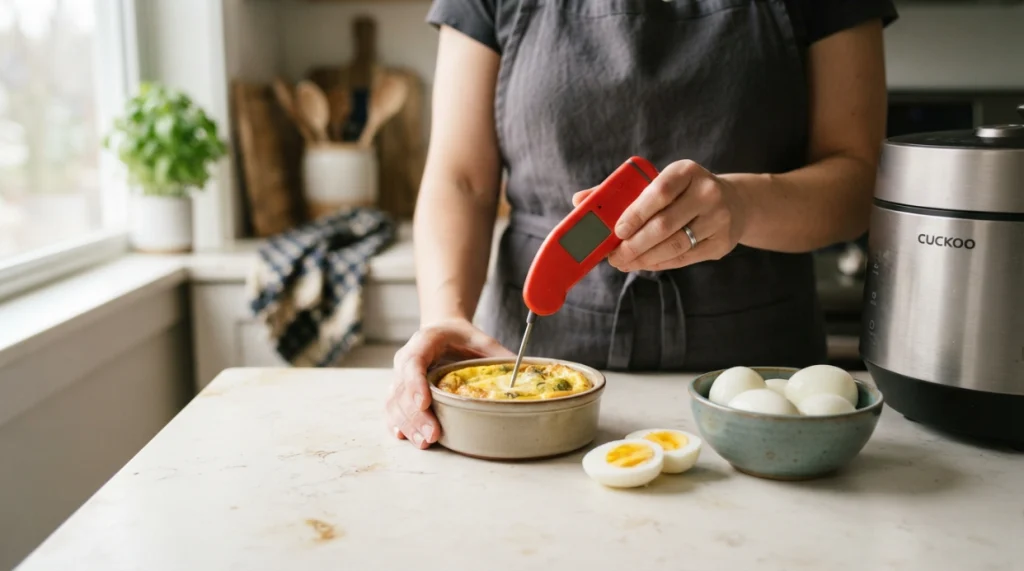
The best check depends on whether you’re cooking whole shell eggs or an egg mixture. For whole eggs, appearance and texture can help, but a food thermometer provides a more objective safety check when appropriate.
Check the egg white and yolk
For a fully cooked egg, the white should be set rather than translucent or slippery. The yolk should also be firm if you’re aiming for a hard-cooked egg.
USDA guidance says eggs should be thoroughly cooked until both the white and yolk are firm. :contentReference[oaicite:4]{index=4}
Use temperature for egg dishes
For scrambled eggs, casseroles, or other dishes made with egg mixtures, the USDA recommends an internal temperature of 160°F (71.1°C). Measure the thickest or center portion of the dish. :contentReference[oaicite:5]{index=5}
This is especially useful when cooking an egg mixture inside a rice cooker. The surface can appear set while the center remains cooler.
Cool cooked eggs promptly
If you’re preparing eggs ahead of time, cool them promptly after cooking and refrigerate them. USDA guidance recommends using cooked eggs within 3 to 4 days when properly refrigerated. :contentReference[oaicite:6]{index=6}
Don’t leave cooked eggs sitting at room temperature for an extended period. Perishable food should generally not remain at room temperature for more than two hours. :contentReference[oaicite:7]{index=7}
As of 2026, the basic safety advice hasn’t changed: cook eggs thoroughly, use safe handling practices, and verify uncertain results rather than relying only on an appliance timer.
Section Takeaway: For firm eggs, check the actual egg rather than trusting the rice cooker alone. For egg dishes, use the 160°F benchmark and check the center.
Frequently Asked Questions
Can you hard boil eggs in a rice cooker?
Yes, you can hard-cook eggs in a rice cooker by steaming them when the appliance supports steaming. Place the eggs above the water, keep the lid closed, and verify that the eggs are fully cooked before serving.
Can I put eggs directly into rice while it cooks?
You can cook eggs with rice in some recipes, but the method differs from steaming whole eggs. If the egg is mixed into the rice, make sure the finished dish reaches 160°F (71.1°C) before eating.
Will eggs crack in a rice cooker?
Eggs can crack during cooking, especially if they are crowded, handled roughly, or exposed to rapid temperature changes. Use intact eggs, avoid unnecessary movement, and place them carefully in the steaming basket.
Can a rice cooker make soft-boiled eggs?
A rice cooker can produce softer eggs when steaming, but getting an exact soft-boiled texture is harder than with a dedicated egg cooker or controlled stovetop method. Cooking time varies by cooker, egg size, and starting temperature.
Is it safe to steam eggs in a rice cooker?
Steaming eggs in a rice cooker can be safe when the appliance is used according to its instructions and the eggs are cooked thoroughly. Avoid bypassing safety controls, handle hot steam carefully, and verify doneness before eating.
Can I cook eggs in a rice cooker without a steaming basket?
You may be able to cook eggs as part of a rice-based recipe, but steaming whole eggs without a suitable rack is less convenient. Don’t place eggs directly on a heating plate unless the manufacturer specifically permits that use.
Why are my rice-cooker eggs undercooked?
Undercooked rice-cooker eggs can result from insufficient water, a short cooking cycle, overcrowding, cold eggs, or a cooker that switches to warm mode too early. Test one egg, then adjust the method while following the appliance manual.
Final Takeaway: Yes, a rice cooker can cook eggs
So, will an egg cook in a rice cooker? Yes, especially when you use the rice cooker as a steamer and place whole eggs in an appropriate steaming basket.
The main limitation is consistency. Rice cookers are designed primarily for rice, so their heating cycles aren’t necessarily optimized for precise egg doneness.
For occasional eggs, I think using the rice cooker you already own is perfectly reasonable. Just test your first batch, keep an eye on food safety, and avoid treating the cook button like a guaranteed egg timer.
If eggs are a daily breakfast staple, a dedicated egg cooker may be worth considering for easier repeatability. But if you’re already cooking rice, a steaming tray can turn your existing appliance into a useful two-in-one cooking tool.
1 thought on “Will an Egg Cook in a Rice Cooker?”