If you have searched “why do eggs explode in an egg cooker,” I know how odd this problem can feel. The first time I heard a loud pop from mine, I thought the cooker had failed.
When I opened the lid, one egg had split wide open. Bits of cooked egg were stuck to the tray and lid.
I later found that the cooker was not always the main problem. Small shell cracks, wrong water levels, trapped steam, and poor egg placement can all play a part.
Here is what I check now before I cook another batch.
Common Signs of the Problem
An egg does not always burst with a loud bang. Sometimes it only cracks and leaks while it cooks.
I have seen white foam come out of the shell and spread over the egg tray. I have also seen shells split near the pointed end.
You may notice:
- A popping sound during cooking
- Cracked or split shells
- Egg white leaking onto the tray
- Foam around an egg
- Pieces of shell under the lid
- Eggs that cook too hard or dry
- A lid that shakes more than normal
| Symptom | Likely Cause | Quick Fix |
|---|---|---|
| Egg cracks early | Weak or damaged shell | Use an intact egg |
| Egg pops while steaming | Trapped air or steam | Follow piercing instructions |
| Several eggs crack | Too much heat or water | Measure water again |
| Egg leaks onto tray | Hairline shell crack | Check eggs before cooking |
I also keep the original water measuring cup with my cooker. The water marks help me avoid guessing.
If your cup is lost or its marks have worn away, a replacement measuring cup can be useful. I would also replace a badly warped egg tray or cracked lid instead of trying to make it fit.
Possible Causes: Why Do Eggs Explode in an Egg Cooker?
The egg shell traps air and moisture inside the egg. As the egg gets hot, that air and moisture expand.
Most egg cookers are made to handle this with gentle steam. Problems start when the shell is weak or the cooking setup is wrong.
The shell already has a small crack
This has been the most common cause in my tests.
A hairline crack can be hard to see when the egg is cold. Once heat reaches it, the crack can grow and the egg white can push out.
I now turn each egg in my hand before cooking. If I see a crack, I use that egg for another dish.
The egg was not pierced when the cooker required it
Some egg cookers tell you to pierce the wide end of the egg. This gives the air pocket a small path to vent.
Other models do not require piercing. I follow the manual for the cooker I am using rather than assuming all egg cookers work the same way.
If your measuring cup has an egg-piercing pin, check the manual before using it.
Too much water was added
Adding more water does not always make eggs cook better. It can make the cooker steam for longer than needed.
I made this mistake when I first used an egg cooker. I filled the plate by eye instead of using the cup.
The eggs became very firm, and one shell split before the cooker stopped.
The eggs are packed too tightly
Large or jumbo eggs may sit very close together in a small tray.
If an egg touches the lid or sits at an odd angle, it may crack as the cooker heats.
The steam vent is blocked
The lid normally has a small steam vent. It should stay open during use.
Food, scale, or dried egg can block it. I check the vent before each batch because trapped steam can make the lid shake and cooking less even.
Mineral scale has built up
Hard water can leave a white or chalky layer on the heating plate.
Scale may change how evenly the plate heats. It can also make cooking times less reliable.
How to Fix Eggs Exploding in an Egg Cooker
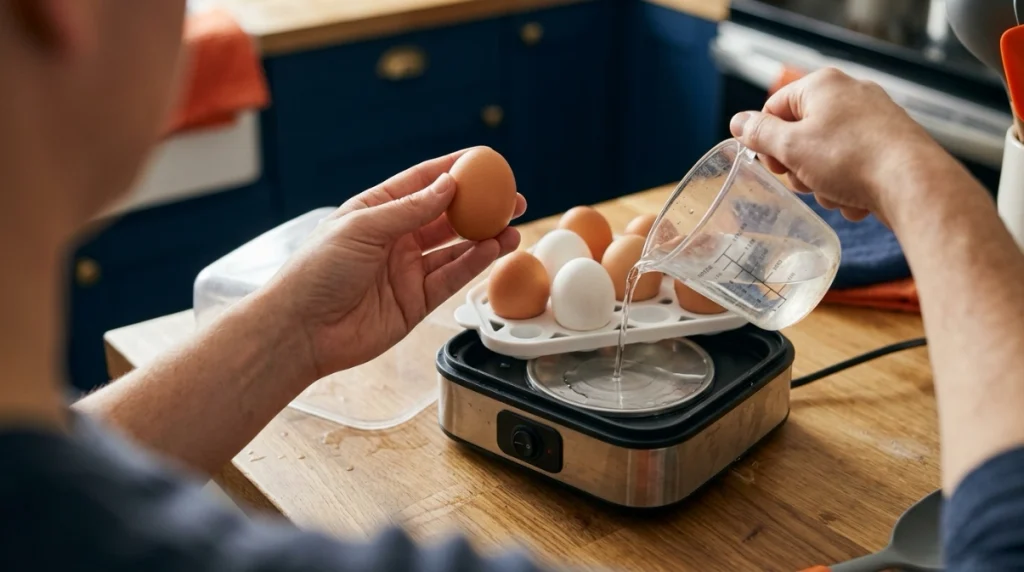
I start with the simple checks first. In most cases, I do not need tools.
| Problem | Recommended Solution | Difficulty |
|---|---|---|
| Cracked shells | Replace damaged eggs | Easy |
| Wrong water level | Use the marked cup | Easy |
| Blocked steam vent | Clear and wash the lid | Easy |
| Scale on heating plate | Descale the plate | Easy |
| Damaged tray or lid | Replace the part | Easy |
| Cooker will not shut off | Stop using the cooker | Do not repair yourself |
Check every egg before cooking
I look at the whole shell under good light.
I do not cook an egg if I see a crack, wet spot, or broken shell. Even a very small crack can grow once steam heats the egg.
Follow the piercing rule for your model
Check your cooker manual.
If it says to pierce the egg, use the supplied pin and make one small hole in the wide end. Do not make several large holes.
If the manual says piercing is not needed, I would not add holes just because another egg cooker uses them.
Measure the water
This fix made the biggest change for me.
I use the water level shown for soft, medium, or hard eggs. I also check whether the amount changes with the number of eggs.
Do not keep adding water because the eggs look large. Use the guide made for your cooker.
Check the egg tray and lid
Place the tray flat and make sure every egg sits in its own spot.
Then fit the lid as the manual shows. Do not force a warped tray or damaged lid into position.
Keep the steam vent open
I check the vent while the cooker is cold and unplugged.
If I find dried egg or scale, I wash it away with a soft cloth or non-abrasive sponge. Never block the vent while the cooker is running.
Remove mineral buildup
About once in a while, I clean the heating plate when I see white scale.
For cookers that allow descaling, I use the maker’s cleaning method. Many models can be treated with diluted white vinegar, but I check the manual first.
I never pour liquid into electrical parts or place the cooker base in water.
Watch the auto shut-off
A normal egg cooker should stop heating or switch modes when its cycle ends.
If mine keeps heating after the water is gone, I unplug it and stop using it. I do not bypass the auto shut-off, safety switch, or overheat protection.
Mistakes to Avoid
The biggest mistake I made was guessing the water level. The measuring cup looked unimportant, but it controls how long many egg cookers steam.
I also avoid these mistakes:
- Cooking eggs with visible cracks
- Blocking the steam vent
- Overfilling the water area
- Forcing jumbo eggs into a small tray
- Touching the lid or steam vent during cooking
- Opening the lid with my face over the cooker
- Pouring cold water onto a hot electrical base
- Scraping the heating plate with metal tools
Steam can burn skin very fast. I let the cooker cool before I touch the plate, tray, or lid.
I would never open a sealed heating unit or try to repair internal wires myself. I would also never bypass a safety switch.
When to Replace the Egg Cooker
A cracked egg does not mean the cooker must be replaced. Most of the time, I can trace the problem to the egg, water level, or setup.
I would stop using the cooker if the base is cracked, the power cord is damaged, or I smell burning from the electrical parts.
I would also replace it if the cooker keeps heating after it should shut off. The same applies if the control buttons fail or the unit shows signs of an electrical fault.
A damaged tray, lid, or measuring cup may be replaceable on its own. The sealed heating system should be left alone.
My Personal Experience
My worst batch happened when I used very cold eggs and guessed the water amount. One egg had a tiny crack that I did not notice.
A few minutes later, I heard a pop. The shell had opened and egg white had spread across the tray.
For my next test, I changed one thing at a time. I checked every shell, measured the water, seated the tray flat, and made sure the lid vent was clear.
I also followed the piercing directions for that cooker.
That batch cooked without a single cracked egg.
The main lesson for me was simple. More water is not better, and small shell cracks matter much more than they seem.
Final Thoughts
So, why do eggs explode in an egg cooker? In most cases, pressure inside a weak shell, a hidden crack, wrong water use, or poor venting is the cause.
Start by checking the eggs and measuring the water. Then inspect the tray, lid, and steam vent.
If the cooker overheats, smells burnt, has a damaged cord, or fails to shut off, stop using it. Those problems are not worth risking an electrical repair at home.
2 thoughts on “Why Do Eggs Explode in an Egg Cooker? Proven Safe Fixes”