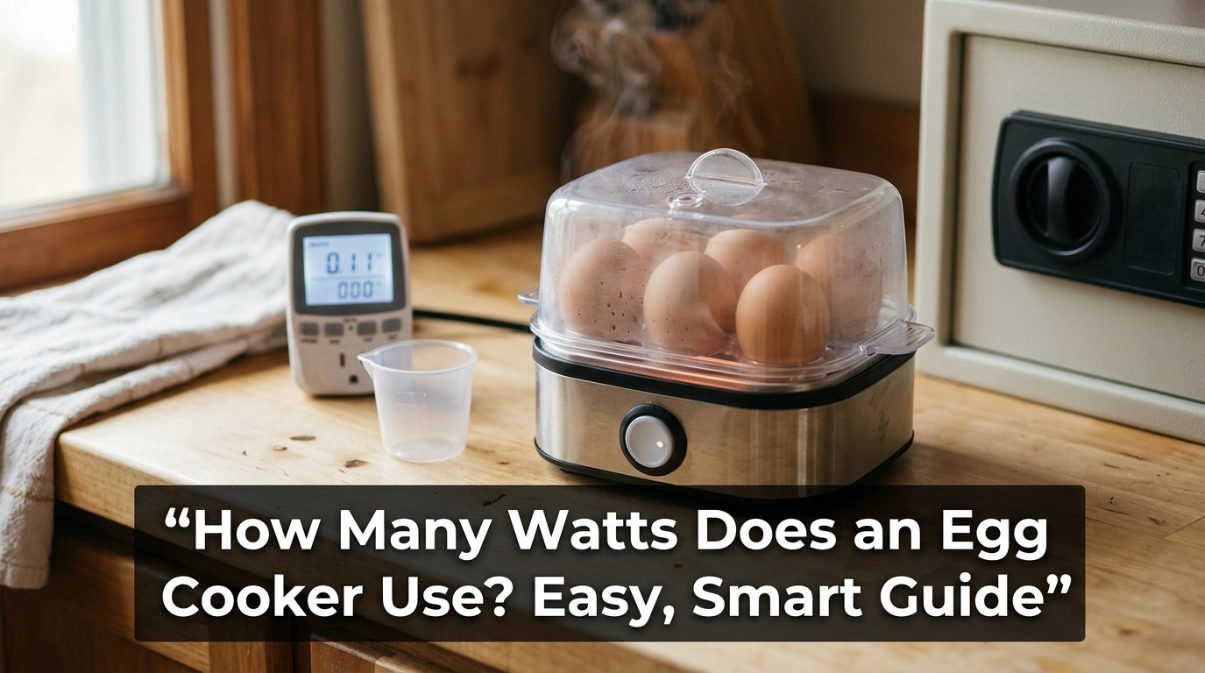
How many watts does an egg cooker use? Most small home models use about 250 to 500 watts while heating. Large units may use 600 watts or a little more.
That number once looked high to me. Yet wattage is only part of the story. An egg cooker runs for a short time, so each batch uses very little power.
In this guide, I will show you how to find the exact wattage. I will also explain odd readings, slow heating, hot plugs, and safe ways to test the unit.
Common Signs of the Problem
The watt number is not often the real problem. Most people ask about it after the cooker starts acting in an odd way.
It may take longer to cook eggs. The plug may feel warm. A breaker may trip, or the heating plate may stop before the eggs are done.
| Symptom | Likely cause | Quick check |
|---|---|---|
| Eggs cook as normal | Wattage is likely normal | Read the rating label |
| Cooker heats very slowly | Low voltage or a weak heater | Try a direct wall outlet |
| Plug becomes very hot | Loose outlet or cord damage | Unplug the cooker |
| Breaker trips | Circuit overload or internal fault | Stop using the unit |
| Power turns off early | Normal auto shut-off or heat fault | Check water and scale |
Many small egg cookers use less power than a toaster, kettle, or microwave. They simply need more time to heat the water.
A missing water measuring cup can still cause trouble. I would replace it with the correct cup if possible. The marks help control cooking time and prevent too much water from extending the heating cycle.
How Much Power Does an Egg Cooker Normally Use?
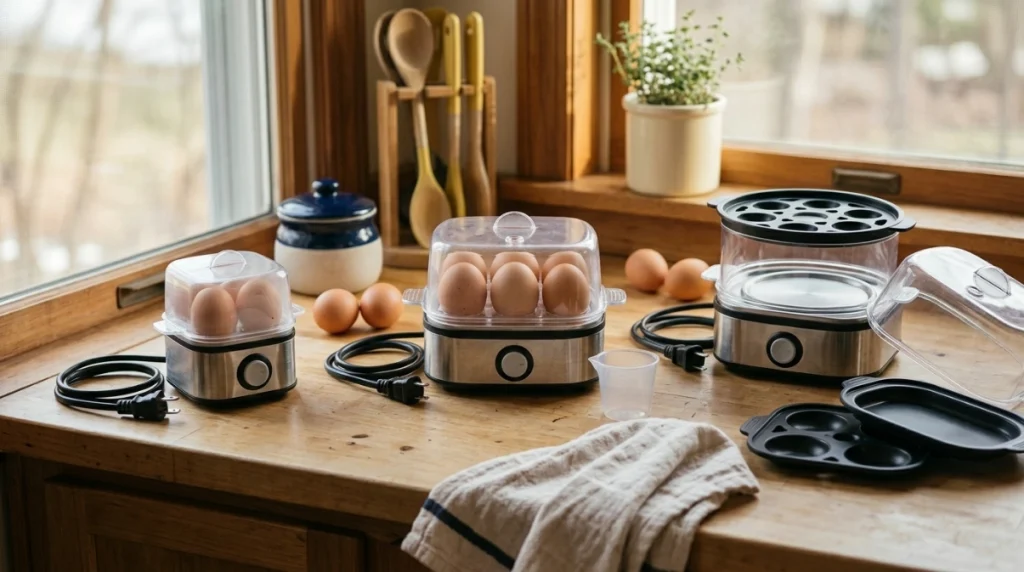
A basic cooker for six or seven eggs often has a rating near 250 to 400 watts. A larger model with poaching or omelet trays may use 400 to 600 watts.
The exact number depends on the heating element. Egg capacity alone does not prove how many watts the cooker needs.
| Egg cooker type | Common rated power | Typical cooking time |
|---|---|---|
| Compact cooker | 250–350 watts | 8–15 minutes |
| Standard cooker | 350–500 watts | 8–18 minutes |
| Large or multi-use model | 500–600+ watts | 10–20 minutes |
These are broad ranges, not fixed rules. The rating printed on your own appliance is the best answer.
A 400-watt cooker running for 15 minutes uses about 0.1 kilowatt-hour. You can calculate it like this:
400 watts ÷ 1,000 × 0.25 hour = 0.1 kWh
Multiply 0.1 kWh by your local electricity rate to find the rough cost per batch. Auto shut-off helps keep the run time short.
Possible Causes of Unusual Power Use
A cooker does not pull its full rated wattage every minute. The reading may rise while the heating plate is on, then fall to zero when the unit shuts off.
A small change is normal. A large change, slow heating, smoke, or a hot cord needs more care.
Common causes include:
- The watt meter is not rated or set correctly.
- The cooker is connected through a poor extension cord.
- The wall outlet has a loose connection.
- Mineral scale covers the heating plate.
- Too much water makes the heating cycle longer.
- The lid or steam vent is not fitted as designed.
- The heating element has begun to fail.
- Another appliance is overloading the same circuit.
- The auto shut-off is cutting power at the right time.
Limescale does not always raise the instant watt reading. It can slow heat transfer, though. That may make the cooker run longer and use more energy per batch.
How to Check How Many Watts an Egg Cooker Uses
Read the Rating Label
Unplug the cooker and look under its base. You may see a label that lists watts, volts, frequency, and a model number.
If the label says 400 W, that is the rated power. It is usually the most useful figure for choosing an outlet or backup power source.
Some labels show amps instead of watts. You can estimate watts by multiplying volts by amps.
For example, 120 volts multiplied by 3 amps is about 360 watts. This is an estimate because real AC power can vary by design.
Check the User Manual
Search the manual for “rated power,” “power consumption,” or “wattage.” Use the exact model number since similar-looking cookers may have different heating elements.
Do not rely on the shipping box alone. A seller may list the wrong figure or mix details from two models.
Measure It With a Plug-In Watt Meter
A plug-in watt meter gives a useful real-time reading. Plug the meter directly into a sound wall outlet, then connect the egg cooker to it.
Add the normal amount of water and start a cooking cycle. Watch the reading during active heating rather than after auto shut-off.
The number may sit a little below the printed rating. Normal household voltage changes and meter accuracy can cause small differences.
Stop the test if you notice a burning smell, sparks, smoke, or a very hot plug. Do not keep running the cooker just to get a final number.
Inspect the Power Source
Connect the cooker straight to a grounded wall outlet that matches its plug. Avoid a light extension lead or loose multi-plug adapter.
A poor connection can create heat at the plug. It can also lower the voltage reaching the heating element and make cooking take longer.
If the outlet looks dark, cracked, or loose, do not use it. Have a qualified electrician inspect it.
Check the Water Amount
More water usually means a longer heating cycle. It does not always increase the cooker’s instant wattage, but it can increase total energy use.
Use the marked measuring cup that came with the cooker. The needed amount may change with egg count and the soft, medium, or hard setting.
Do not let the heating plate run dry unless the manual says that is part of normal operation. Incorrect water can trigger overheat protection.
Remove Mineral Buildup
A white or brown layer on the heating plate is often mineral scale. It can slow heating and leave the eggs less cooked than expected.
Unplug the unit and let it cool first. Follow the manual’s descaling directions. A little white vinegar may be suitable, but only if the maker allows it.
For routine cleaning, I use a soft cloth or non-abrasive sponge. Metal scrubbers can scratch the plate and damage its finish.
Keep the base, cord, switch, and electrical plug out of water. Never place the powered base in a sink or dishwasher.
Test One Normal Cooking Cycle
Use eggs of a similar size, the right tray, and the correct water mark. Make sure the lid is seated and the steam vent is open.
Note the starting time, peak watt reading, and shut-off time. One controlled test is more useful than comparing two batches with different water levels.
| Finding | Recommended action | Difficulty |
|---|---|---|
| Reading is near the label rating | Keep using it normally | Easy |
| Normal watts but slow cooking | Descale and check water | Easy |
| Far below rating with weak heat | Try another safe outlet | Easy |
| Hot or damaged cord | Stop using the cooker | Easy |
| Smoke or repeated breaker trips | Replace or seek service | Professional |
What a Low or High Reading Means
A reading slightly below the rating is not a fault by itself. A 400-watt appliance may not display exactly 400 watts on a basic meter.
A very low reading paired with slow heating may point to low supply voltage, a bad connection, or a weak heating element. Test only with a safe outlet.
A reading above the printed rating may be a brief meter change. If it stays far above the label, stop using the cooker and check the manual or manufacturer support.
Repeated breaker trips are never a normal way for auto shut-off to work. A breaker points to an overloaded circuit, a short, or another electrical issue.
Mistakes to Avoid
Do not compare egg cookers by wattage alone. A higher-watt unit may finish sooner, so it may not use much more total energy.
Do not use a damaged extension cord to test the cooker. Thin cords and loose adapters may heat up under load.
Never cover the steam vent. Hot steam needs a safe path out of the lid. Keep your face and hands away when lifting it.
Do not open the sealed base to inspect the heating element. It may hold live parts and heat protection devices.
Never bypass the safety switch, thermostat, or auto shut-off. These parts help prevent dry heating and fire.
Do not pour water onto a hot, plugged-in plate. Unplug the unit and wait for it to cool before wiping or descaling it.
When to Replace the Egg Cooker
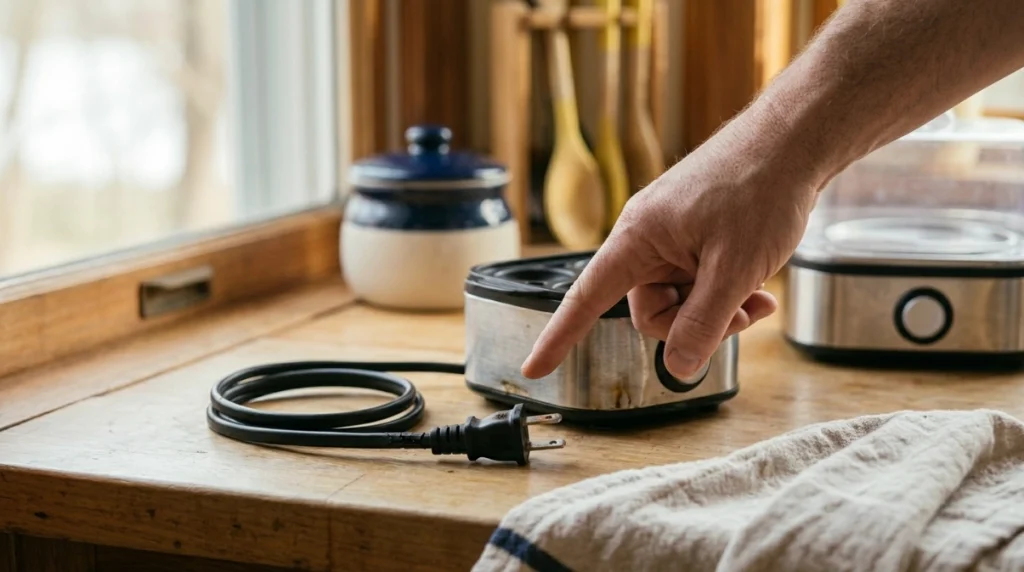
Replace the cooker if its cord is split, the plug is scorched, or the base has melted areas. Those faults are not safe home repairs.
Replacement also makes sense if the unit produces smoke, a sharp burning smell, or repeated breaker trips. Stop using it as soon as any of these signs appear.
A failed internal heating element is rarely worth repairing in a low-cost cooker. The sealed base should only be checked by a qualified appliance technician.
A cracked lid, worn measuring cup, or damaged egg tray may not require a whole new cooker. Use only parts made for the exact model and safe temperature range.
My Personal Testing Method
My practical check starts with the bottom label. This avoids guesswork and tells me what the maker expects the cooker to draw.
Next, I check the water mark, lid, steam vent, cord, and heating plate. I have found that adding extra water can make a normal cooker seem wasteful because it runs much longer.
I then use a plug-in watt meter for one standard batch. I compare the active reading with the rating label, but I do not expect both numbers to match down to the last watt.
The most useful lesson is to track both watts and time. A normal watt reading with a long cycle often points to excess water or mineral scale, not an electrical surge.
Final Thoughts
So, how many watts does an egg cooker use? Most models use around 250 to 500 watts, while larger units may use 600 watts or more.
Check the label under your cooker for the exact rating. If needed, confirm it with a properly rated plug-in watt meter during a normal heating cycle.
Small differences are common. Stop using the cooker if the cord overheats, the unit smells burnt, smoke appears, or a breaker keeps tripping.