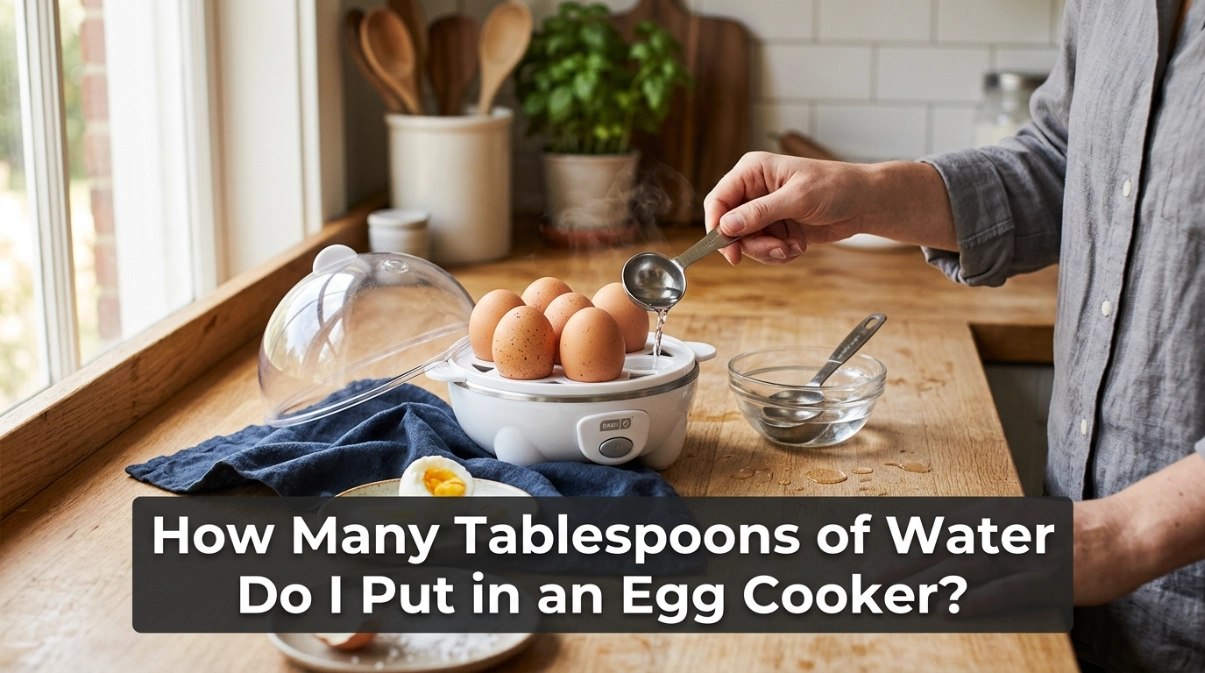
If you are asking, “how many tablespoons of water do I put in an egg cooker,” start with 2 to 4 tablespoons. Use less for soft eggs and more for hard eggs.
That is a general starting point, not one fixed rule. Egg cookers differ in size, heat, tray shape, and shut-off design.
When I lost my small water cup, I first added water by eye. That gave me soft whites, wet yolks, and very mixed results.
I then measured each batch with a tablespoon. This made it much easier to find an amount that worked with my cooker.
Quick Water Amount Guide
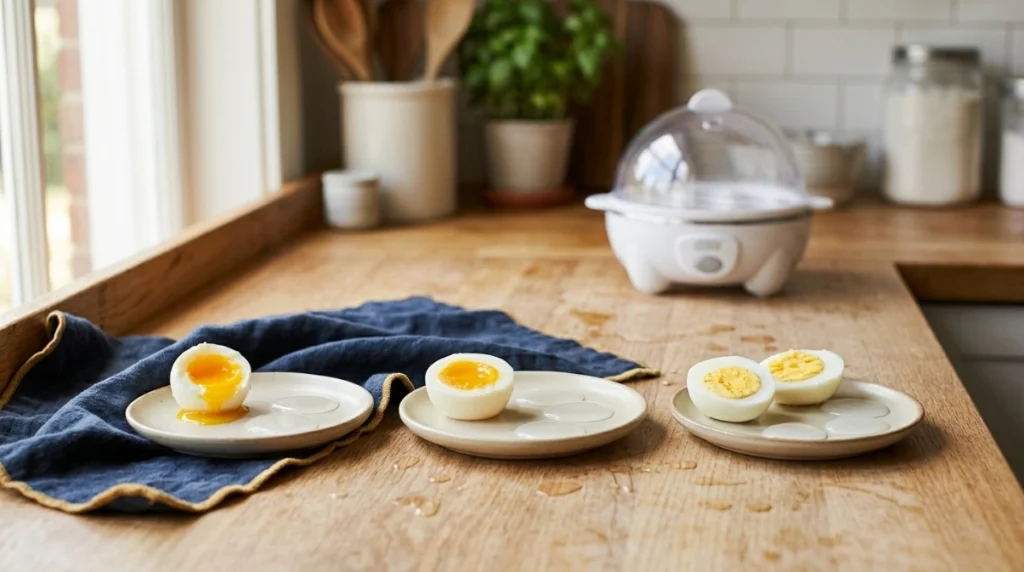
For many small electric egg cookers, these amounts offer a useful starting point:
| Egg result | Water to start with | Approximate amount |
|---|---|---|
| Soft-boiled | 2 tablespoons | 30 ml |
| Medium-boiled | 3 tablespoons | 45 ml |
| Hard-boiled | 4 tablespoons | 60 ml |
One US tablespoon holds about 15 milliliters. Four tablespoons are equal to 1/4 cup.
Always check your manual or marked measuring cup first. Some cookers need less water, while large models may need more.
A replacement measuring cup can help if the original is lost. I prefer one with clear soft, medium, and hard marks because small water changes affect the final yolk.
Common Signs of the Problem
The first sign of too little water is an egg that is not done. The white may look wet, or the yolk may be softer than planned.
Too much water creates the reverse problem. The cooker steams for longer, so the yolk may become dry, pale, or firm.
You may also notice these signs:
- The cooker shuts off before the eggs are done.
- Water remains on the heating plate.
- Steam escapes from the side of the lid.
- Egg results change from one batch to the next.
- The heating plate makes a dry sizzling sound too soon.
- The alarm or auto shut-off takes much longer than normal.
| Symptom | Likely cause | Quick fix |
|---|---|---|
| Wet egg white | Too little water | Add 1/2 tablespoon next time |
| Dry or gray yolk | Too much water | Reduce water by 1/2 tablespoon |
| Uneven eggs | Tray or lid is out of place | Refit both parts |
| Long cooking cycle | Excess water | Measure a smaller amount |
| Early shut-off | Low water or scale | Add water or descale the plate |
Possible Causes
Wrong water measurement is the most common cause. A kitchen spoon is not always a true tablespoon, so it can give a different amount each time.
Egg size also matters. Large, cold eggs often need a little more steam than small eggs kept near room temperature.
The number of eggs may affect some models. Yet other cookers use nearly the same water amount for one egg or a full tray. This is why the manual remains important.
Other likely causes include:
- The water measuring cup is being read from the wrong side.
- The heating plate has mineral buildup.
- The lid is not sitting flat.
- A steam vent is blocked.
- The egg tray is upside down or loose.
- Water leaked before the cycle started.
- The wrong cooking mark was used.
- The eggs were very cold or extra-large.
A cooker does not always run for a set time. Many basic models stop when the water has boiled away. More water usually means a longer cooking cycle.
How to Fix How Many Tablespoons of Water Do I Put in an Egg Cooker
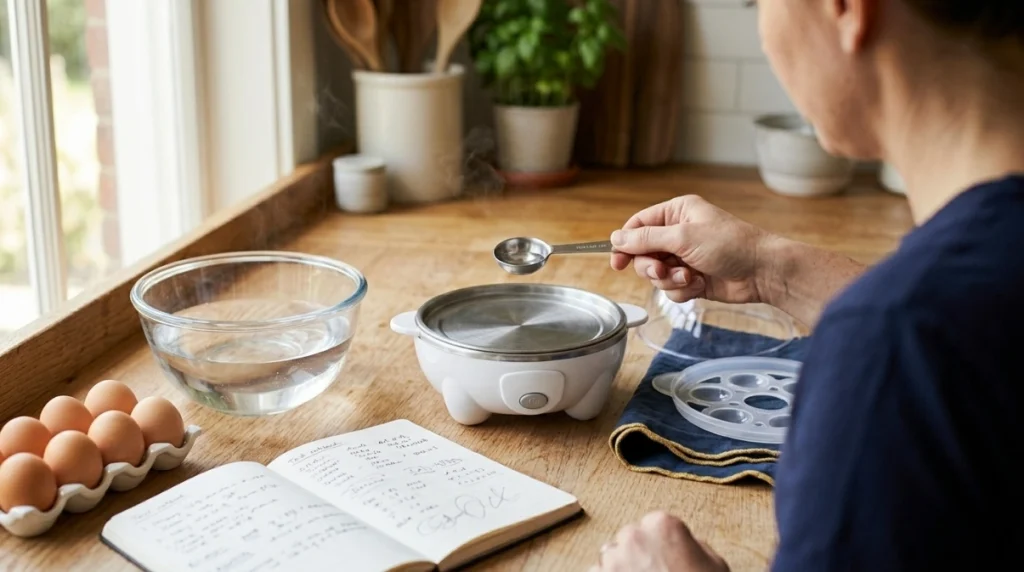
Check the Manual Before Measuring
Look for the model number on the base. Then check the manual for its water chart.
If the manual gives milliliters, divide that number by 15. For example, 45 ml is about 3 tablespoons.
Do not use a general chart over a brand-specific chart. The maker’s amount is designed for that heating plate and tray.
Start With a Safe Test Amount
If the manual and cup are missing, start with 2 tablespoons for soft eggs. Use 3 tablespoons for medium eggs or 4 tablespoons for hard eggs.
Test only a small batch at first. Let the cooker finish its normal cycle without lifting the lid.
Check one egg after cooling it in cold water. If it is too soft, add another 1/2 tablespoon during the next test.
If it is too firm, remove 1/2 tablespoon. Small changes worked much better for me than adding a full spoon at once.
Use a Real Measuring Spoon
A normal eating spoon may hold more or less than one tablespoon. This can make each batch different.
I use a level 1-tablespoon measure. I also pour the water on a flat surface so I can see the amount well.
| Problem | Recommended solution | Difficulty |
|---|---|---|
| Original cup is missing | Use a 15 ml tablespoon | Easy |
| Eggs are too soft | Add 1/2 tablespoon | Easy |
| Eggs are too hard | Remove 1/2 tablespoon | Easy |
| Results keep changing | Record each test amount | Easy |
| White scale is present | Descale the heating plate | Easy |
Inspect the Egg Tray and Lid
Set the egg tray flat on its support. A tilted tray can make steam move around the eggs in an uneven way.
Make sure the lid is fully seated. Keep the steam vent open, and never cover it with a cloth or plate.
Steam must escape through the intended vent. Keep your hands and face away from it while the cooker is running.
Check for Mineral Buildup
White or brown marks on the heating plate can slow heat transfer. This may make the correct water amount seem wrong.
Unplug the cooker and let it cool. Use the maker’s descaling steps, or wipe the plate with diluted white vinegar if the manual allows it.
For cleaning, I use a soft cloth or non-abrasive sponge. I do not scrape the plate with a knife or steel pad.
Wipe away all vinegar before the next batch. Never put the powered base under running water.
Test the Auto Shut-Off
Many egg cookers stop or sound an alarm when the water is gone. This means water controls both steam and cooking time.
If the unit stops with lots of water left, unplug it. Let it cool before checking the tray, plate, and safety switch position.
Do not hold down, tape, or bypass a safety switch. If the shut-off system fails more than once, stop using the cooker.
Adjust for Egg Size and Temperature
Extra-large eggs may need 1/2 tablespoon more than medium eggs. Very cold eggs can also take slightly longer to set.
Try to use eggs of a similar size in one batch. Mixed sizes may give you both soft and firm yolks at the same time.
Keep notes for your own cooker. My best hard-boiled result came from using the same egg size and the same exact water measure each time.
Mistakes to Avoid
Do not fill the heating plate to the top without checking its limit. Excess water may leak, splash, or keep the unit running too long.
Never add water while the cooker is plugged in or hot. A sudden splash can cause burns and may reach electrical parts.
Avoid these common mistakes:
- Using a serving spoon instead of a measuring spoon
- Guessing the amount from the depth of the water
- Blocking the steam vent
- Opening the lid toward your face
- Touching the tray before it cools
- Running the cooker without water
- Pouring water near the cord or control button
- Using more water to fix a damaged heating element
Unplug the unit if you smell burning, see damaged insulation, or notice water beneath the base. Do not open a sealed heating unit or attempt unsafe wire repairs.
When to Replace the Egg Cooker
A wrong water amount does not mean the cooker needs replacement. Most poor results can be fixed by measuring water and adjusting it in small steps.
Replacement makes sense when the power cord is split, the base leaks, or the heating plate no longer warms. A failed shut-off system is also a serious warning.
| Repair issue | Safe response | Replace instead? |
|---|---|---|
| Lost measuring cup | Use a tablespoon or replacement cup | No |
| Light mineral scale | Descale as directed | No |
| Cracked removable lid | Replace the correct lid | Usually no |
| Water leaking from base | Stop using the cooker | Yes |
| Failed auto shut-off | Stop using the cooker | Usually yes |
| Burnt cord or plug | Unplug at once | Yes |
Only use a replacement lid or tray made for the exact model. A poor fit may leak steam or stop a safety switch from working.
My Personal Experience
My first test used two tablespoons with large eggs from the fridge. The whites set, but the middle of each yolk stayed quite soft.
For the next batch, I used three tablespoons. The yolks became firm around the edge but stayed soft in the center.
Four tablespoons gave me hard-boiled eggs in my small cooker. I then cooled them in ice water to stop the cooking.
I also learned that adding a random splash ruined my test. Once I began using a true tablespoon, the results became far more steady.
The best lesson was to change only one thing at a time. I kept the egg size and batch size the same, then changed the water by 1/2 tablespoon.
Final Thoughts
So, how many tablespoons of water do I put in an egg cooker? A good starting range is 2 tablespoons for soft eggs, 3 for medium eggs, and 4 for hard eggs.
Your exact amount may differ by model. Follow the marked cup or manual whenever you have it.
If you must test, adjust the water by only 1/2 tablespoon per batch. That simple method helped me get steady results without overfilling the cooker or guessing.