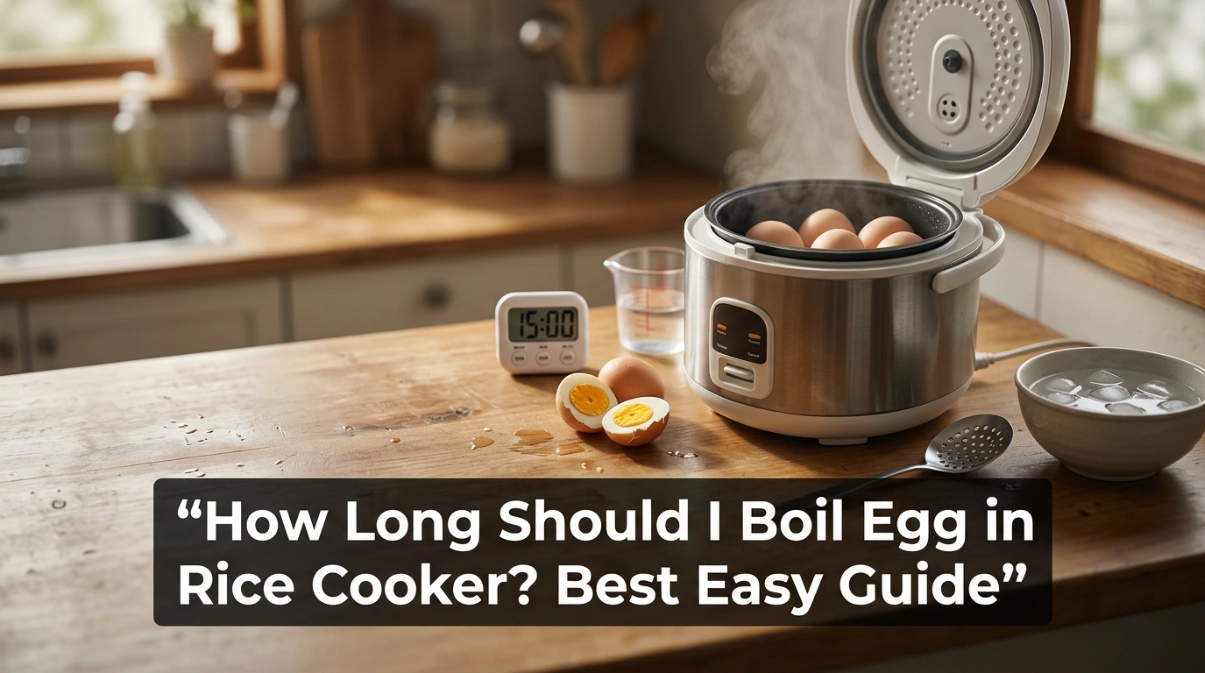
If you are asking, “how long should I boil egg in rice cooker,” the short answer is 10 to 15 minutes after the water starts to steam. Cook for less time for a soft yolk and longer for a firm yolk.
My first batch did not go well. I counted the time from the moment I pressed Cook. The water took several minutes to heat, so my timing was wrong.
After a few tests, I found that the steam time matters most. In this guide, I will share the times that worked, why eggs may cook too fast or too slowly, and how to fix common problems.
Quick Rice Cooker Egg Cooking Times
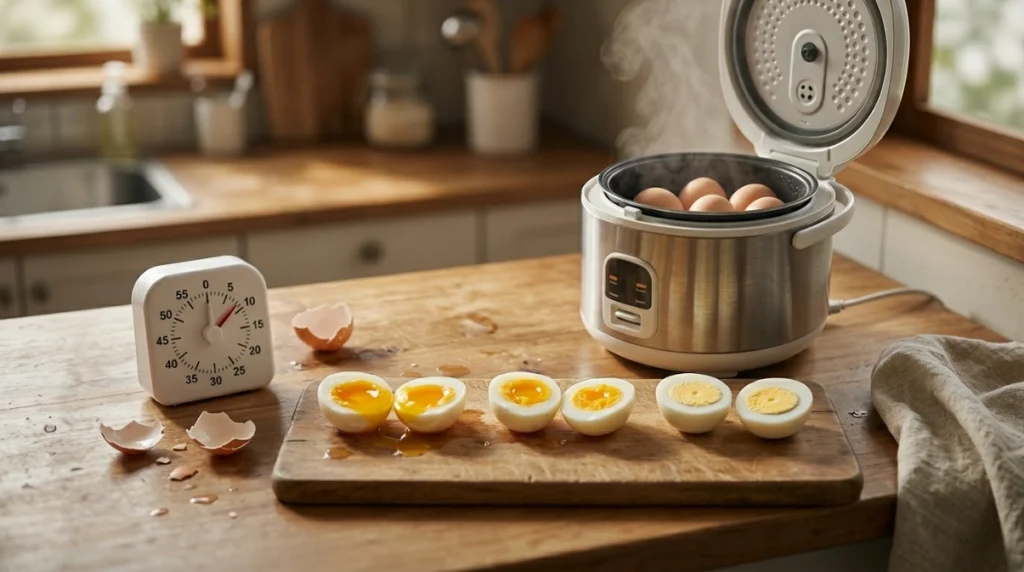
The times below begin when the water starts to boil or makes steady steam. Heating the water may add another 5 to 10 minutes.
| Egg result | Time after steaming starts | Yolk texture |
|---|---|---|
| Soft-boiled | 6–8 minutes | Runny or very soft |
| Medium-boiled | 9–11 minutes | Jammy and moist |
| Hard-boiled | 12–15 minutes | Fully firm |
I usually start checking hard-boiled eggs at 12 minutes. Large, cold eggs may need closer to 15 minutes.
A basic kitchen timer helped me more than the cooker’s switch. A rice cooker often changes to Warm based on heat, not on the exact firmness of the egg.
I also keep a small measuring cup near the cooker. It helps me add the same amount of water each time. There is no need to buy an egg tray unless you plan to steam the eggs above the water.
Common Signs of the Problem
The most common issue is an egg that does not match the result you wanted. It may be too soft, too firm, cracked, or hard to peel.
Here are the signs I noticed while testing:
- The white is firm, but the yolk is still runny.
- The yolk has a dry or pale edge.
- The shell cracks while the water heats.
- Water dries out before the eggs are ready.
- The cooker changes to Warm too soon.
- Steam leaks from the side of the lid.
- Eggs cook at different rates in one batch.
A green-gray ring around the yolk is another clear sign. It does not mean the egg is unsafe, but it often means the egg cooked too long or cooled too slowly.
| Symptom | Likely cause | Quick fix |
|---|---|---|
| Runny yolk | Cooking time was too short | Cook 2–3 minutes longer |
| Dry, firm yolk | Egg cooked too long | Reduce the time |
| Cracked shell | Fast heat or shell damage | Lower eggs in with care |
| Uneven eggs | Crowded pot | Use one even layer |
| Water runs dry | Too little water | Add enough to keep boiling |
Possible Causes
There is no single perfect time for every rice cooker. The size and style of the cooker can change how fast an egg cooks.
These are the main causes of poor results:
- Egg size: Large eggs need more time than small eggs.
- Starting temperature: Cold eggs may take longer than room-temperature eggs.
- Water temperature: Hot water reaches a boil sooner.
- Rice cooker power: A high-power unit heats water faster.
- Number of eggs: A full pot can need a little more time.
- Cooking method: Eggs in water may cook faster than eggs on a steam tray.
- Altitude: Water boils at a lower heat in high places.
- Lid position: An open steam vent is normal, but a loose lid may waste heat.
Mineral scale can also slow the heating process. I noticed this when the bottom of my cooker had a dull white film. The water took longer to make steady steam.
Do not block the steam vent to make the cooker heat faster. Hot steam needs a safe way to escape.
How to Fix How Long Should I Boil Egg in Rice Cooker
The safest method is to use enough water, watch for steady steam, and start a separate timer. Do not depend only on the Cook or Warm light.
Choose Boiling or Steaming
For the boiling method, place the eggs in one layer. Add enough water to cover them by about one inch.
Close the lid and press Cook. Once the water boils, start your timer. Use 6 to 8 minutes for soft eggs or 12 to 15 minutes for hard eggs.
For steaming, add about one to two cups of water. Set the eggs in a heat-safe steam tray above the water, then close the lid.
Steamed eggs often need about 8 to 10 minutes for a soft center and 13 to 16 minutes for a firm center. The exact time depends on the tray height and steam strength.
Check the Water Amount
Too little water can dry out before the eggs cook. Too much water is not unsafe, but it takes longer to heat.
I add enough water to cover boiled eggs without filling past the cooker’s maximum line. For steaming, I add enough water to keep making steam for the full cooking time.
Never pour water onto the outer base or power connection. Remove the inner pot before filling it when the cooker’s design allows this.
Start Timing at the Right Moment
My biggest mistake was starting the timer as soon as I turned on the rice cooker. That made each batch hard to compare because the heating time changed.
Start counting when you hear a steady boil or see a regular flow of steam. This gives you a much more useful cooking time.
If your cooker traps steam well, begin at the low end of the range. You can always cook an egg for another minute, but you cannot soften an overcooked yolk.
Test One Egg First
When using a new cooker, test one or two eggs before cooking a full batch. I used one large cold egg and checked it after 12 minutes of steady steam.
The yolk was almost firm, so I added two minutes to the next batch. That small test helped me find the right time without wasting many eggs.
Write down the water amount and time that work for your cooker. Once you know them, later batches become much easier.
Cool the Eggs at Once
Move cooked eggs into a bowl of ice water for at least five minutes. This stops the heat inside the egg from cooking the yolk further.
Cooling also made peeling easier in my tests. I tap the wide end first because that is where the small air pocket is often found.
Use tongs or a spoon when lifting hot eggs. The pot, lid, water, and escaping steam can cause burns.
Check the Lid and Steam Vent
A lid that does not sit well lets too much heat escape. This can add several minutes to the cooking time.
Check that the lid is in place and that the steam vent is open. Replace a cracked lid only with one made for your cooker model.
Do not hold the lid down or cover the vent. Also, open the lid away from your face and hands because a strong cloud of steam may escape.
Remove Mineral Buildup
Scale on the inner pot or heating area can make the cooker heat slowly. Unplug the cooker and let every part cool before you begin cleaning.
Wash the removable pot with a soft cloth or non-abrasive sponge. For safe descaling, follow the maker’s guide. Diluted white vinegar may help if the manual allows it.
Do not soak the electrical base. Never scrape a heating plate with a knife or metal pad.
| Problem | Recommended solution | Difficulty |
|---|---|---|
| Eggs are too soft | Add 2 minutes | Easy |
| Eggs are overcooked | Use less cooking time | Easy |
| Heating is slow | Remove safe-to-clean scale | Easy |
| Lid leaks badly | Check fit or replace lid | Easy |
| Cooker will not heat | Test the outlet, then stop use | Moderate |
Check the Cook and Warm Settings
Some basic rice cookers switch to Warm when the pot reaches a set heat. This may happen after much of the water is gone.
That switch does not measure the yolk. Remove the eggs when your timer ends, even if the cooker still shows Cook.
If the cooker switches off before the water heats, unplug it and let it cool. Check that the inner pot sits flat and that its outer base is dry.
Mistakes to Avoid
Do not pierce an egg with a sharp tool unless your cooker’s own manual tells you to do so. A cracked egg can leak into the water and make a mess.
Avoid packing eggs in two or three layers. Eggs at the bottom may cook faster, while the top eggs may stay soft.
Other mistakes to avoid include:
- Starting the timer before the water boils
- Forgetting to use an ice bath
- Touching the steam vent
- Filling beyond the maximum line
- Running the cooker without enough water
- Using a damaged power cord
- Placing a wet inner pot on the heating base
- Leaving hot eggs on Warm for a long time
Never open the electrical base or sealed heating unit. Do not bypass its switch, fuse, temperature control, or overheat protection.
Unplug the cooker if you smell burning, see smoke, hear odd electrical sounds, or find melted parts. Do not keep testing it with food inside.
When to Replace the Rice Cooker
A timing problem alone does not mean you need a new cooker. Changing the water amount or cooking time will fix most egg problems.
Replacement is safer when the cord is split, the plug becomes very hot, or the cooker gives off a burning smell. A damaged heating plate or a switch that fails to stay on also needs expert attention.
| Repair issue | Likely choice | Replace instead? |
|---|---|---|
| Loose or cracked lid | Replace matching lid | Usually no |
| Worn inner pot coating | Replace the inner pot | Often |
| Damaged cord | Professional service | Often yes |
| Burning smell from base | Stop using the cooker | Yes |
| Cooker will not heat | Check warranty or service | Often yes |
Do not make a home electrical repair unless you are trained to do it. A low-cost rice cooker is often safer to replace than to open and repair.
My Personal Experience
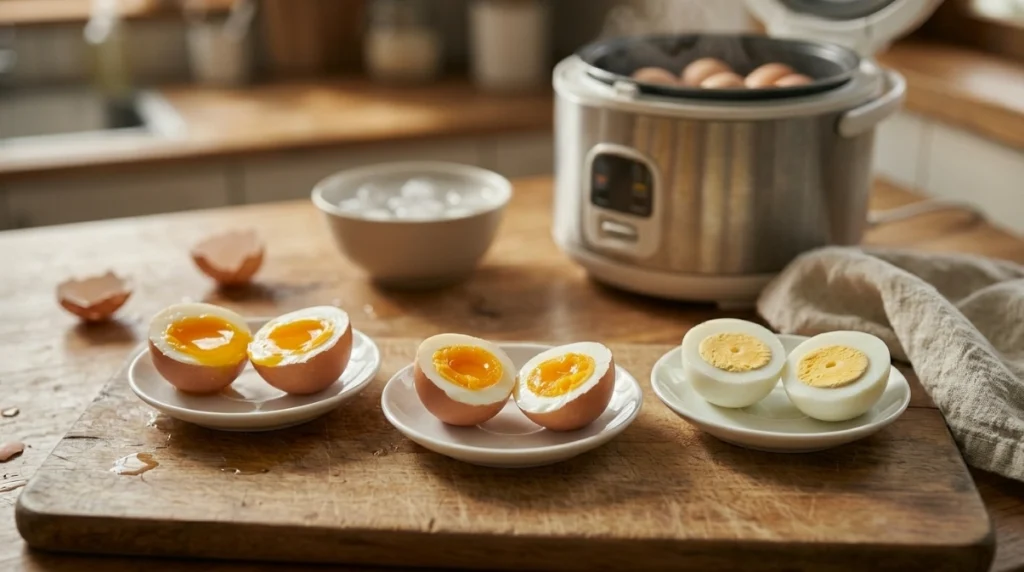
I tested large eggs straight from the fridge. For my first batch, I covered them with water and started counting as soon as I pressed Cook.
That batch was too firm because I left the eggs in the hot water after the cooker changed modes. The yolks also had a faint gray edge.
On my next try, I waited for a steady boil. I cooked one egg for 8 minutes, one for 10 minutes, and one for 13 minutes.
The 8-minute egg had a soft center. The 10-minute egg was jammy. The 13-minute egg was fully set without being too dry.
The ice bath made the largest difference after timing. It stopped carryover heat and gave me a more steady result.
I also learned that my cooker needed a bit more time when I added six cold eggs. Adding one or two minutes fixed that batch.
Final Thoughts
So, how long should i boil egg in rice cooker? Start timing once the water boils. Use 6 to 8 minutes for soft eggs, 9 to 11 minutes for medium eggs, and 12 to 15 minutes for hard-boiled eggs.
Test one egg because rice cookers vary. Use enough water, keep the steam vent clear, and cool each egg in ice water as soon as it is done.
If results are still poor, check the lid, water level, scale buildup, and Cook setting. Stop using the cooker if its cord, plug, or heating base shows signs of electrical damage.