

6 Best Santoku Knives (2026): Japanese and German Picks Compared
KitchAdvisor is reader-supported. As an Amazon Associate we earn from qualifying purchases, at no extra cost to you.
The best santoku knife for most home cooks is the Henckels Solution 2-Piece Santoku Knife Set. You get both a 7-inch and a 5.5-inch santoku from a German brand with more than 100 years of knife-making history, the blades are stain and rust resistant, and the set can go in the dishwasher.
A santoku is a Japanese-style all-purpose knife with a flat edge, a rounded sheep’s-foot tip and a thinner blade than a typical Western chef knife. It shines at slicing, dicing and mincing vegetables, boneless meat and fish with an up-and-down chopping motion. Below we compare six santoku knives on steel, edge angle, blade length, handle and care, so you can pick the one that suits your hand and your cooking.

Our Top Picks at a Glance
| Award | Product | Our Score |
|---|---|---|
| Best Overall | Henckels Solution 2-Piece Santoku Knife Set (5.5" and 7") | 4.7/5 |
| Best Japanese Steel | HOSHANHO 7-Inch Japanese Santoku Knife | 4.6/5 |
| Best Value | imarku 7-Inch Santoku Knife with Pakkawood Handle | 4.5/5 |
| Best Small Santoku | WÜSTHOF Gourmet 5-Inch Hollow Edge Santoku Knife | 4.5/5 |
| Sharpest Edge | SANMEIHO 7-Inch Santoku Knife (10Cr15MoV) | 4.3/5 |
| Best Budget | Cuisinart Graphix Collection 7-Inch Santoku Knife | 4.2/5 |
The 6 Best Picks Reviewed
1. Henckels Solution 2-Piece Santoku Knife Set (5.5" and 7") – Best Overall
Best Overall
Henckels Solution 2-Piece Santoku Knife Set (5.5" and 7")

Rating: ★★★★½ 4.7/5
Research-based editorial score from verified specs, materials, design and buyer-use factors.
Best For: Home cooks who want two useful santoku sizes from a trusted brand with easy care.
Key Specs
2 knives: 7-inch and 5.5-inch santoku • German-engineered stainless steel • Stain and rust-free blades • Lightweight • Dishwasher safe or hand wash • About 0.7 lb total
Key Advantage
Two sizes for big and small jobs, a trusted name and simple care.
Main Trade-off
No hollow-edge scallops, so starchy potatoes can cling a little more.
Henckels is the value line from Zwilling J.A. Henckels, and the Solution set is aimed squarely at everyday cooking. You get a 7-inch santoku for onions, cabbage and boneless chicken, and a 5.5-inch santoku that is easier to control for shallots, garlic, herbs and fruit.
The blades are German-engineered stainless steel and are lightweight, which many cooks find less tiring than heavier forged knives during long prep sessions. Henckels says the blades start razor sharp and stay sharp with minimal care.
The set can go in the dishwasher, which is handy, but hand washing and drying straight away will keep the edges sharper for longer. If you only want one santoku, the 7-inch knife alone covers most jobs, but having the smaller one at no big extra cost is a real convenience.
Pros
- Two santoku sizes in one box
- Lightweight and easy to control
- Stain and rust-free blades
- Dishwasher safe
Cons
- Plain edge, no hollow scallops
- No sheath or block included
2. HOSHANHO 7-Inch Japanese Santoku Knife – Best Japanese Steel
Best Japanese Steel
HOSHANHO 7-Inch Japanese Santoku Knife

Rating: ★★★★½ 4.6/5
Research-based editorial score from verified specs, materials, design and buyer-use factors.
Best For: Cooks who want a thin, very sharp Japanese edge with an attractive Pakkawood handle.
Key Specs
7-inch blade • Three-layer laminated steel with 10Cr15CoMoV core • Hand-sharpened 15° edge • Frosted blade finish • African Pakkawood handle • About 0.77 lb • Gift box
Key Advantage
Premium cobalt-alloy core steel and a fine 15-degree edge.
Main Trade-off
Hand wash only, and the thin edge needs a careful touch.
HOSHANHO forges this santoku from three layers of laminated steel around a 10Cr15CoMoV core. That cobalt-containing steel can be hardened more than common budget steels, which helps the edge hold longer between sharpenings.
The edge is hand sharpened to 15 degrees, sharper than the roughly 20 degrees used on many German knives. Thin slices of tomato, cucumber and raw fish come away cleanly. The frosted blade finish looks distinctive and helps hide light scratches.
The African Pakkawood handle is smooth and shaped to fill the hand. Like most thin Japanese-style knives, it should be hand washed and kept away from bones and frozen food.
Pros
- 10Cr15CoMoV core steel
- Sharp 15-degree edge
- Comfortable Pakkawood handle
- Gift box
Cons
- Hand wash only
- Thin edge can chip on bone
3. imarku 7-Inch Santoku Knife with Pakkawood Handle – Best Value
Best Value
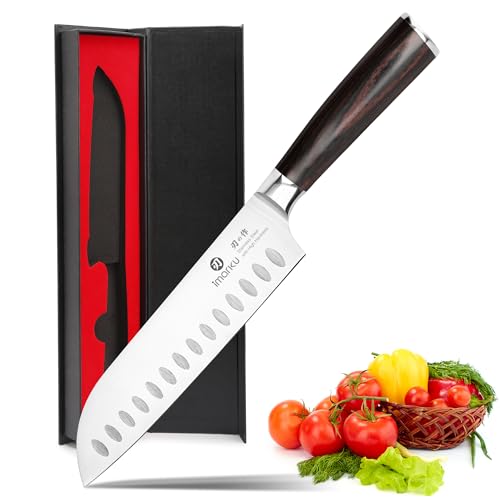
imarku 7-Inch Santoku Knife with Pakkawood Handle
Rating: ★★★★½ 4.5/5
Research-based editorial score from verified specs, materials, design and buyer-use factors.
Best For: Cooks who want a hollow-edge santoku that releases food, at a friendly price.
Key Specs
7-inch blade • Japanese high-carbon stainless steel • Hollow (scalloped) edge • Pakkawood handle • About 0.43 lb • Gift box
Key Advantage
Hollow-edge scallops reduce sticking, and the light weight is easy on the wrist.
Main Trade-off
Steel grade is not stated in detail.
imarku’s 7-inch santoku is one of the most popular budget santoku knives. The blade has a scalloped hollow edge that creates small air pockets between the steel and the food, so slices of potato, cucumber and cheese fall away instead of clinging to the blade.
At around 0.43 pounds it is light and nimble, and the Pakkawood handle is shaped to reduce wrist strain. The high-carbon stainless steel resists rust and discoloration with normal care.
It arrives in a black gift box, which makes it an easy present for a new cook.
Pros
- Hollow edge reduces sticking
- Very light and nimble
- Pakkawood handle
- Good value
Cons
- Exact steel grade not listed
- Hand washing recommended
4. WÜSTHOF Gourmet 5-Inch Hollow Edge Santoku Knife – Best Small Santoku
Best Small Santoku
WÜSTHOF Gourmet 5-Inch Hollow Edge Santoku Knife

Rating: ★★★★½ 4.5/5
Research-based editorial score from verified specs, materials, design and buyer-use factors.
Best For: Small hands, small kitchens and cooks who want a compact second knife from a top German brand.
Key Specs
5-inch blade • Laser-cut, stamped high-carbon stainless steel • Hollow edge • 10-degree cutting edge per WÜSTHOF • Synthetic polypropylene handle • Made in Solingen, Germany • About 0.25 lb • Hand wash only • Limited lifetime warranty
Key Advantage
A Solingen-made WÜSTHOF with a thin, sharp edge in a compact size.
Main Trade-off
5 inches is too short for big vegetables like cabbage or squash.
WÜSTHOF has been family owned for seven generations and makes its knives in Solingen, Germany. The Gourmet line uses precise laser-cut stamped blades, which keeps them lighter and more affordable than the brand’s forged Classic line.
This 5-inch santoku has a thinner blade than a chef knife, a hollow edge to reduce sticking, and a fine cutting edge. It is ideal for herbs, garlic, shallots, small fruits and boneless chicken breasts.
The polypropylene handle resists fading, heat and impact. WÜSTHOF asks for hand washing only, and backs the knife with a limited lifetime warranty.
Pros
- Made in Solingen, Germany
- Hollow edge
- Compact and very light
- Limited lifetime warranty
Cons
- Too short for large produce
- Hand wash only
5. SANMEIHO 7-Inch Santoku Knife (10Cr15MoV) – Sharpest Edge
Sharpest Edge
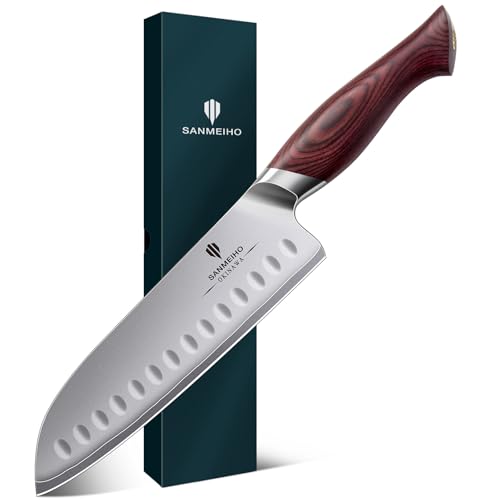
SANMEIHO 7-Inch Santoku Knife (10Cr15MoV)
Rating: ★★★★☆ 4.3/5
Research-based editorial score from verified specs, materials, design and buyer-use factors.
Best For: Experienced cooks who want an extra-fine edge for thin slicing.
Key Specs
7-inch blade • Five-layer laminated steel with 10Cr15MoV core • Up to 62 HRC (per maker) • Hand-sharpened 12° edge each side • Matte frosted finish • Pakkawood handle • About 0.49 lb • Gift box
Key Advantage
A very acute 12-degree edge for paper-thin cuts.
Main Trade-off
The fine edge is more delicate and needs careful use and storage.
SANMEIHO grinds this santoku to just 12 degrees per side, one of the sharpest angles you will find on a mass-market kitchen knife. That makes it excellent for paper-thin vegetables, sashimi-style fish and delicate herbs.
The blade is built from five layers of laminated steel around a 10Cr15MoV core, which the maker says reaches up to 62 HRC. Harder steel holds a fine edge longer, but it is also less forgiving if you twist the blade or hit bone.
The matte frosted finish and Pakkawood handle give it a clean modern look. Treat it as a precision slicer and keep a sturdier knife for hard squash and bone-in meat.
Pros
- Very sharp 12-degree edge
- Hard laminated steel
- Comfortable Pakkawood handle
Cons
- Delicate edge can chip
- Newer brand with a shorter track record
6. Cuisinart Graphix Collection 7-Inch Santoku Knife – Best Budget
Best Budget
Cuisinart Graphix Collection 7-Inch Santoku Knife

Rating: ★★★★☆ 4.2/5
Research-based editorial score from verified specs, materials, design and buyer-use factors.
Best For: Budget buyers who want a familiar brand and a lifetime warranty.
Key Specs
7-inch blade • High-carbon stainless steel • Precision-tapered ground edge • Textured stainless handle • About 0.62 lb • Lifetime warranty
Key Advantage
A low-cost, all-stainless santoku with a lifetime warranty.
Main Trade-off
The all-metal handle is less grippy than wood or synthetic handles.
Cuisinart’s Graphix santoku is a simple, sturdy knife at a modest price. The high-carbon stainless steel blade is precision-tapered to a fine edge, and the one-piece stainless handle has a textured pattern for grip.
It is a sensible choice for a first kitchen, a rental or a backup knife. Cuisinart backs it with a lifetime warranty.
Pros
- Low cost
- Lifetime warranty
- Easy-to-clean all-steel build
Cons
- Metal handle can feel slippery when wet
- Edge is not as fine as Japanese-style picks
Side-by-Side Comparison
| Knife | Length | Steel | Edge | Handle |
|---|---|---|---|---|
| Henckels Solution | 7″ + 5.5″ | German stainless | Plain | Synthetic |
| HOSHANHO | 7″ | 10Cr15CoMoV, 3-layer | 15° | Pakkawood |
| imarku Pakkawood | 7″ | High-carbon stainless | Hollow | Pakkawood |
| WÜSTHOF Gourmet | 5″ | High-carbon stainless | Hollow | Polypropylene |
| SANMEIHO | 7″ | 10Cr15MoV, 5-layer | 12° | Pakkawood |
| Cuisinart Graphix | 7″ | High-carbon stainless | Plain | Stainless |
How to Choose a Santoku Knife
Blade length
Seven inches is the classic santoku size and handles most jobs, from onions to boneless chicken. A 5 to 5.5-inch santoku is easier to control for small produce and suits smaller hands. If you cook for a family, start with a 7-inch blade.
Steel and hardness
Japanese-style steels such as 10Cr15CoMoV and 10Cr15MoV are usually hardened more than German steels, so they hold a fine edge longer but can chip if twisted. German stainless is softer and tougher, which makes it more forgiving for everyday use.
Edge angle
Santoku knives are often sharpened to 12 to 15 degrees per side, compared with about 20 degrees for many German chef knives. A smaller angle cuts more cleanly but needs more care. Match the angle when you resharpen.
Hollow edge or plain
Hollow-edge (scalloped) blades have small dimples that let air between the steel and the food. They help with starchy potatoes, cucumbers and cheese. A plain edge is easier to sharpen all the way along.
Handle
Pakkawood is a resin-infused wood that feels warm and resists moisture. Synthetic handles are tough and low maintenance. All-steel handles are easy to clean but can be slippery when wet.
Santoku vs. Chef Knife: Which Do You Need?
A Western chef knife has a curved belly that suits a rocking motion, and its pointed tip is good for detail work. A santoku has a flatter edge and a rounded tip, so it works best with a straight up-and-down chop or a forward push cut.
Many cooks find a santoku lighter and less intimidating than an 8-inch chef knife. If you mostly cut vegetables and boneless proteins, a santoku can be your main knife. If you often break down whole chickens or large roasts, a chef knife is the better primary blade. See our best chef knife guide to compare.
What a Santoku Does Best
- Dicing onions, carrots, celery and peppers with a straight chopping motion.
- Thin slicing of cucumbers, tomatoes and mushrooms.
- Mincing garlic, ginger and fresh herbs.
- Slicing boneless chicken, beef and fish for stir-fries.
- Scooping chopped food onto the wide, flat blade to move it to the pan.
Santoku Care and Sharpening
- Hand wash and dry right after use, even if the knife is labeled dishwasher safe.
- Cut on wood or plastic boards. Glass, stone and ceramic dull edges fast.
- Avoid bones, frozen food and hard squash rinds with thin Japanese-style blades.
- Hone gently and sharpen at the knife’s original angle, usually 12 to 15 degrees for Japanese-style santokus.
- Store in a block, on a magnetic strip or with a blade guard, never loose in a drawer.
Safe Cutting Habits
A sharp knife is safer than a dull one because it needs less force. Use the claw grip, keeping fingertips curled under, and place a damp towel under your board so it does not slide. Our knife and cut safety guide has more tips.
The santoku’s name is often translated as “three virtues”, referring to slicing, dicing and mincing. You can read more about the style in the santoku article on Wikipedia. If you would rather buy several knives at once, see our best kitchen knife set picks.
Frequently Asked Questions
What is a santoku knife used for?
Slicing, dicing and mincing vegetables, boneless meat and fish. Its flat edge works best with straight up-and-down or push cuts.
Is a santoku better than a chef knife?
Neither is better overall. A santoku is lighter and great for vegetables; a chef knife is more versatile for rocking cuts and larger proteins.
What size santoku knife should I buy?
A 7-inch santoku suits most cooks. A 5 to 5.5-inch model is better for small hands or small prep jobs.
Do hollow-edge santoku knives really work?
They help reduce sticking with starchy or wet foods like potatoes and cucumbers, though they do not stop it completely.
Can santoku knives go in the dishwasher?
Some are labeled dishwasher safe, but hand washing protects the edge and handle. Thin Japanese-style blades should always be hand washed.
What angle should I sharpen a santoku?
Most santokus use 12 to 15 degrees per side. Check the maker’s spec and keep the same angle.
Final Verdict
The Henckels Solution 2-Piece Santoku Knife Set is the best santoku knife pick for most homes, with two useful sizes, a trusted brand and easy care.
Choose the HOSHANHO for premium Japanese steel, the imarku for hollow-edge value, the WÜSTHOF Gourmet for a compact German knife, the SANMEIHO for the sharpest edge, or the Cuisinart Graphix on a tight budget.
Related reading:
One Comment