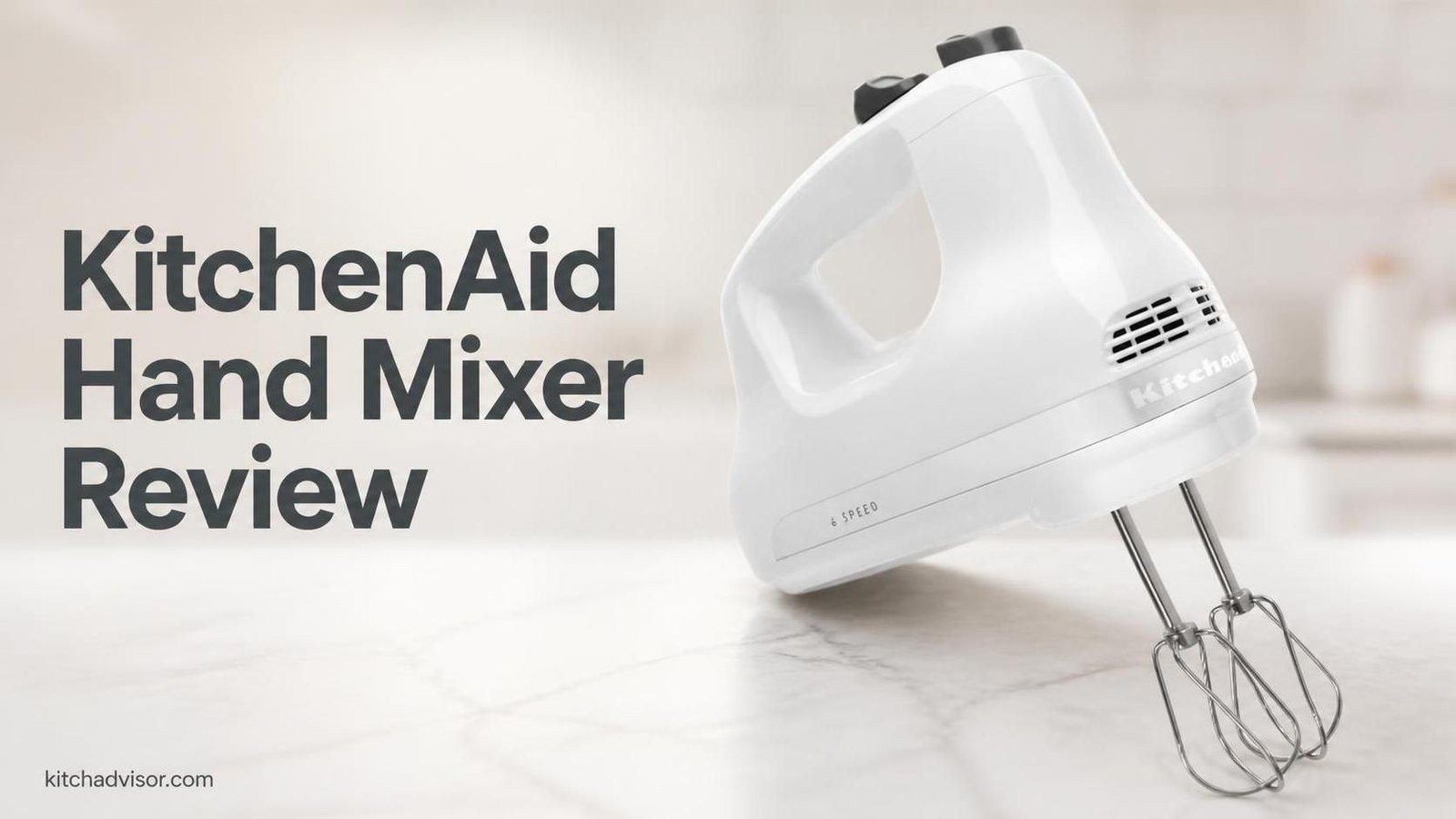
The KitchenAid hand mixer is a handheld electric kitchen appliance designed to beat, whip, and combine ingredients for everyday cooking and baking. It helps home cooks prepare cake batter, cookie mixtures, whipped cream, and other recipes without needing a countertop stand mixer. KitchenAid offers several hand mixer configurations, ranging from straightforward everyday models to options with additional speeds and specialized attachments, so the exact model matters when comparing performance and value.
This review examines the product category represented by the supplied KitchenAid hand mixer image while separating verified brand information from unconfirmed model details. Because the exact model number could not be established from the supplied information, model-specific specifications, included accessories, and performance claims remain unconfirmed.
🏆 My Quick Verdict
💡 Best For: Home bakers seeking a handheld mixer for everyday batters, whipping, and ingredient preparation, subject to model verification.
⚡ Key Specs
Product category: electric hand mixer; brand: KitchenAid; exact model, speed count, motor specifications, and included attachments: unverified.
✅ Bottom Line: KitchenAid offers hand mixers suited to different baking needs, but the right choice depends on the specific model and accessory package. Confirm the product listing before purchasing rather than assuming every KitchenAid hand mixer has the same features.

At a Glance
- Designed for mixing, beating, and whipping ingredients in everyday recipes.
- KitchenAid’s hand mixer range includes models with different speed counts and attachment packages.
- Potential applications include cake batter, cookie mixtures, egg whites, and whipped cream, depending on the model and attachment.
- The exact motor rating, speed count, dimensions, and weight of the supplied product remain unverified.
- Attachment compatibility and dishwasher-safe components must be checked against the selected model’s documentation.
- Compare the complete package and warranty terms before making a purchase.
Specifications
| Specification | Verified information |
|---|---|
| Brand | KitchenAid |
| Product type | Handheld electric mixer |
| Speed settings | Exact model not identified |
| Motor power | Not verified |
| Included attachments | Not verified |
| Corded or cordless | Not verified |
| Dimensions and weight | Not verified |
| Warranty | Check the applicable regional warranty |
Design and Build Quality
A hand mixer’s design matters because it influences handling, control, and storage. KitchenAid’s range includes different configurations, so the precise housing design, finish, handle shape, and attachment arrangement should be evaluated against the actual model rather than assumed from the brand name.
For comfortable everyday use, look for a grip that feels secure and a control layout that allows speed changes without awkward hand movements. The appliance should also feel manageable when held above a mixing bowl for several minutes.
Storage deserves attention, too. Check whether the package includes an accessory storage solution and whether the cord can be secured neatly, if applicable.
Setup, Installation and Ease of Use
- Unpack the mixer and compare every supplied component with the manufacturer’s included-parts list.
- Read the model-specific instructions before connecting the appliance to a power source.
- Inspect beaters and other attachments for visible damage before fitting them.
- Insert each attachment into its designated opening and confirm that it locks securely according to the manual.
- Choose a stable mixing bowl with enough room for the ingredients to move without overflowing.
- Begin at the lowest appropriate speed and increase it gradually as the mixture becomes more uniform.
- Switch the mixer off and disconnect it before removing attachments or cleaning the appliance.
- Store the dry attachments in a clean drawer or the supplied storage container, if included.
Core Performance and Feature Breakdown
A hand mixer’s usefulness depends on how well its speed range and attachments match the recipes you prepare. KitchenAid’s official product range includes different speed configurations, including five-, six-, seven-, and nine-speed models, as well as cordless options.
Lower speeds are useful for beginning to combine ingredients with less splashing, while faster settings support whipping and incorporating air into suitable mixtures. Actual control and performance depend on the selected model, ingredients, attachment, and quantity.
Expert Insight
More speed settings do not automatically mean better results for every recipe. Matching the attachment and speed to the mixture, starting gently, and avoiding overfilling the bowl can matter as much as the number of available settings.
Attachments can expand a mixer’s usefulness beyond basic cake batter. Depending on the package, KitchenAid models may include beaters, a whisk, dough hooks, a blending rod, or specialized beaters designed to improve contact with the bowl.
Do not assume every accessory comes standard. The manufacturer’s product guidance specifically notes that accessories can differ between hand mixer models.
Key Features Explained
Variable Speed Control
Multiple speed settings allow users to adjust how quickly ingredients are combined or aerated. KitchenAid’s models vary in their available speeds, so verify the precise range before deciding whether it suits delicate mixtures, general baking, or frequent whipping.
Beater Attachments
Standard beaters are intended for common mixing jobs such as cake batter and cookie mixtures. Some models use specialized beater designs, but their presence and compatibility should be confirmed in the product listing.
Whisk and Dough Attachments
A whisk can help aerate cream and egg whites, while suitable dough hooks are designed for particular dough-mixing tasks. These accessories are not universal across the entire product range, and a hand mixer should not automatically be treated as a substitute for a stand mixer when preparing large or stiff doughs.
Corded and Cordless Options
KitchenAid sells both corded hand mixers and cordless models in its broader lineup. Cordless operation offers freedom from a nearby outlet, but battery inclusion and charging requirements must be checked for the exact package.
Real-World Usability and Maintenance
For everyday baking, a hand mixer can reduce the effort required to combine ingredients compared with mixing manually. It is especially useful for smaller preparations where bringing out a full stand mixer would add unnecessary setup and cleanup.
Cleaning starts with separating the removable attachments according to the instruction manual. Only components specifically identified as dishwasher-safe should be placed in the dishwasher; the motor housing should be cleaned according to the manufacturer’s directions rather than immersed in water.
Allow attachments to dry completely before storing them. Inspect the cord, plug, attachment sockets, and controls periodically, and discontinue use if you notice damage or unusual operation.
Pros and Cons
Pros
- Handheld format suits many everyday mixing tasks without requiring a stand mixer.
- The KitchenAid lineup provides several speed configurations to suit different preferences.
- Selected models offer additional attachments for more varied preparation tasks.
- Both corded and cordless options are available across the broader range.
Cons
- The exact model and its specifications remain unconfirmed from the supplied information.
- Accessory availability varies, so the desired tools may not be included.
- A hand mixer may be unsuitable for large batches or demanding dough work.
Common Issues and Fixes
Ingredients Splash Out of the Bowl
Starting too quickly can scatter flour or liquid around the work surface. Switch off the mixer, reduce the speed, and restart with the beaters positioned inside the mixture.
Attachments Do Not Fit Properly
Incorrect or incompatible attachments may not seat securely in the mixer. Consult the model manual and use only the specified accessories without forcing them into place.
Mixing Results Are Uneven
Ingredients that are not combined consistently can leave lumps or unmixed material around the bowl. Stop the mixer, scrape the bowl with a suitable utensil, and continue at an appropriate speed.
What to Know Before You Buy
The most important check is the exact model number, because KitchenAid sells several hand mixers that look similar but have different features. Confirm the number in the listing title, product details, packaging, or manufacturer’s documentation before relying on any specification.
Next, compare the included attachments with your regular cooking habits. If you mostly make cake batter and cookie mixtures, basic beaters may be sufficient, while frequent whipping or specialized preparation may justify a model with a suitable whisk or other accessories.
Check the electrical requirements and plug type for your country before ordering an imported appliance. A US-market product may not be directly suitable for a different electrical system, and a simple plug adapter does not convert voltage.
Finally, verify the seller, return policy, and regional warranty coverage. Do not rely on a warranty statement from another country’s product page without checking whether it applies to your purchase.
Who Should Buy It and Who Should Skip It
✅ Who Should Buy It
- Home bakers who regularly prepare cakes, batters, and whipped mixtures.
- People who prefer a handheld appliance over a countertop mixer for smaller tasks.
- Buyers willing to compare the model’s attachments and speed settings before purchasing.
- Households that want a dedicated tool for routine mixing and beating.
✗ Who Should Skip It
- Bakers who regularly prepare large batches or heavy doughs and need a stand mixer.
- Buyers who require confirmed specifications but cannot identify the exact model.
- People who need cordless operation but have not verified battery inclusion.
- Purchasers who need guaranteed local warranty support without checking regional terms.
Alternatives to Consider
Two other KitchenAid configurations illustrate the differences worth considering when choosing a hand mixer. These are alternatives within the same brand rather than a claim that either is the exact product pictured.
KitchenAid 5-Speed Ultra Power Hand Mixer
Best For: Everyday mixing and buyers who prefer a straightforward speed range.
Main Advantage: The manufacturer describes this configuration as a compact option for everyday mixing needs.
Trade-off: It offers fewer speed settings than the brand’s higher-speed configurations.
Key Spec: Five speed settings.
KitchenAid 6-Speed Hand Mixer with Flex Edge Beaters
Best For: Bakers who want specialized beaters for routine batter preparation.
Main Advantage: Its Flex Edge Beaters are designed to increase mixing surface contact and reduce the need to scrape the bowl.
Trade-off: The exact benefit depends on the recipe, and the accessory design may not be necessary for every user.
Key Spec: Six speed settings and two Flex Edge Beaters.
Is It Worth It?
A KitchenAid hand mixer can be a sensible choice for households that regularly bake and want a compact appliance for routine mixing. Its overall value depends on whether the specific configuration provides the speed range and attachments you actually need.
Before deciding, compare the complete package rather than the brand name alone. A less expensive configuration may cover everyday recipes adequately, while an upgraded model can make sense when its additional accessories solve a genuine cooking need.
Because the supplied image does not establish the exact model, a definitive value judgment on this particular listing would be premature. Confirm its identity and compare the seller’s offer with the manufacturer’s published details first.
Final Verdict
The KitchenAid hand mixer range offers practical options for everyday baking, but this specific product cannot be rated reliably until its exact model is identified. Verify the model number, attachments, electrical compatibility, and warranty before buying; those details matter more than assumptions based on appearance alone.
Frequently Asked Questions
1. What can a KitchenAid hand mixer be used for?
A KitchenAid hand mixer can beat, mix, and whip ingredients for many everyday recipes. Common uses include cake batter, cookie mixtures, cream, and egg whites, depending on the model and attachment.
2. How many speeds does this KitchenAid hand mixer have?
The exact speed count cannot be confirmed without identifying the model. KitchenAid sells configurations with different numbers of speed settings, including five-, six-, seven-, and nine-speed models.
3. Are KitchenAid hand mixer attachments interchangeable?
Compatibility depends on the specific mixer and attachment. Check the manufacturer’s compatibility information before buying replacement beaters, whisks, or dough hooks.
4. Is a KitchenAid hand mixer suitable for bread dough?
Suitability depends on the mixer, attachment, and dough recipe. Use only attachments approved for the model, and consider a stand mixer for large batches or stiff doughs.
5. Are the beaters dishwasher-safe?
Dishwasher safety depends on the supplied attachment and model instructions. Check the manual before washing any removable component in a dishwasher, and never immerse the motor housing.
6. What warranty does this hand mixer include?
The applicable warranty cannot be verified without the exact model and sales region. Check the warranty documentation, seller terms, and local service availability before ordering.
Affiliate disclosure: KitchAdvisor earns a small commission when you purchase through links on this page — at no extra cost to you. Our editorial process is independent: affiliate relationships never influence which products we recommend or how we rank them.