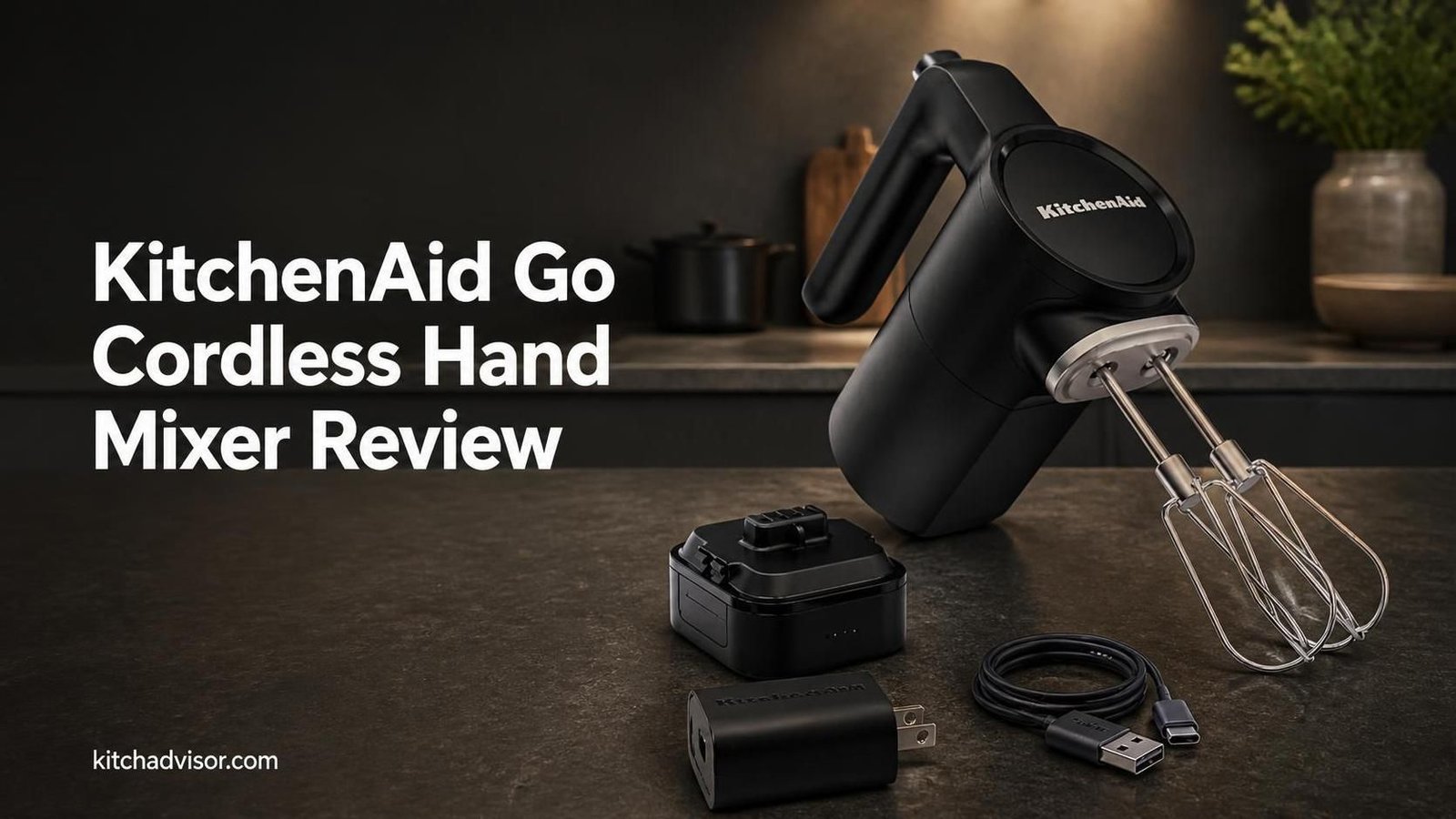
The KitchenAid Go Cordless Hand Mixer is a rechargeable, handheld electric mixer designed for everyday baking and food preparation without a power cord. It helps home cooks stir, mix, and whip ingredients wherever they have room to work, making it especially appealing to bakers who value mobility and a less cluttered countertop.
This KitchenAid Go Cordless Hand Mixer review examines its verified features, battery arrangements, usability, limitations, and overall value for home kitchens. It is a premium-oriented alternative to traditional corded hand mixers, but the right purchase depends on your baking habits and whether you already own a compatible KitchenAid Go battery.
Enhanced Quick Verdict
🏆 My Quick Verdict
💡 Best For: Home bakers who want cordless convenience, adjustable mixing speeds, and freedom to move around the kitchen.
⚡ Key Specs:
Seven speeds, rechargeable removable 12V MAX battery, up to 60 minutes of advertised continuous runtime, stainless steel Turbo Beater II accessories, and Soft Start technology.
✅ Bottom Line: This mixer offers useful mobility and controlled mixing for everyday recipes. Its strongest appeal is eliminating the cord, while battery management and the premium purchase cost deserve consideration before buying.
Product Image

At a Glance
- The cordless design lets you mix without staying beside an electrical outlet.
- Seven speed settings provide flexibility for different everyday mixing tasks.
- Soft Start gradually brings the beaters up to speed to help reduce splashing.
- The manufacturer advertises up to 60 minutes of continuous runtime under variable usage conditions.
- The battery-included and battery-excluded versions have different upfront equipment requirements.
- Dishwasher-safe stainless steel Turbo Beater II accessories simplify routine cleanup.
Specifications Table
| Specification | Verified Information |
|---|---|
| Product category | Cordless electric hand mixer |
| Product family | KitchenAid Go |
| Speeds | 7 |
| Battery | Removable rechargeable 12V MAX battery system |
| Advertised runtime | Up to 60 minutes of continuous use |
| Mixing accessories | Stainless steel Turbo Beater II accessories |
| Starting control | Soft Start technology |
| Included battery | Depends on the selected model |
Specifications are based on KitchenAid’s published information for its US-market battery-included and battery-excluded versions. Runtime varies with recipe, attachment use, battery condition, and operating conditions.
Design and Build Quality
The KitchenAid Go Cordless Hand Mixer combines a handheld mixing body with a removable battery system. Its free-standing design allows the mixer to rest upright between mixing intervals, helping keep the beaters away from the work surface.
The included Turbo Beater II accessories are made from stainless steel, according to KitchenAid. This provides a durable, reusable mixing attachment rather than relying on disposable accessories.
The cordless construction is the most significant design difference from a conventional electric hand mixer. There is no power cord to drag across the counter, although the battery still needs charging and adds another component to store.
Exact dimensions and weight should be checked against the specific regional listing before purchase, particularly if compact storage is essential. The supplied product image alone is not sufficient to verify those measurements.
Setup, Installation and Ease of Use
- Confirm whether the selected version includes the rechargeable battery before opening the package.
- Charge the battery using the supplied charging equipment and the instructions for your model.
- Install the compatible battery securely according to the manufacturer’s instructions.
- Insert the supplied beaters into their designated openings until properly seated.
- Place the beaters into the ingredients before starting the mixer to help control splashing.
- Select an appropriate speed and increase it gradually when the recipe requires more mixing power.
- Use the ejector control as directed to remove the beaters before cleaning.
- Clean the removable accessories according to their dishwasher-safe guidance and keep the motor body away from immersion.
- Store the mixer and battery in a dry location, following the manufacturer’s battery-storage recommendations.
Core Performance and Feature Breakdown
The mixer’s main performance advantage is controlled everyday mixing without a cord. Its seven-speed design accommodates different tasks, while Soft Start is intended to reduce the sudden burst of ingredients that can occur when beaters start too aggressively.
For cake batter, pancake mixtures, frosting, whipped cream, and similar kitchen preparations, adjustable speed can make it easier to begin gently and increase mixing intensity as needed. The appropriate setting still depends on ingredient consistency and the recipe.
Expert Insight
Treat the advertised 60-minute runtime as an upper-limit manufacturer claim, not a guarantee for every recipe. Mixing resistance, speed selection, battery age, and attachment choice affect actual operating time, so demanding batches may require more careful battery planning.
The stainless steel beaters are intended for thorough mixing, and their dishwasher-safe construction reduces the effort involved in cleaning after baking. However, this is still a hand mixer, not a stand mixer designed to operate independently while you perform other tasks.
KitchenAid does not position the seven-speed control as a replacement for choosing the correct appliance for heavy kneading. Buyers who frequently prepare bread dough or other exceptionally demanding mixtures should compare the mixer with equipment specifically intended for those jobs.
Product Image
Key Features Explained
1. Cordless Operation
The rechargeable battery removes the need to remain near an electrical outlet while mixing. This is particularly useful when moving between work surfaces, preparing food in a compact kitchen, or working where outlet placement is inconvenient.
2. Seven Speed Settings
Seven speeds let users adapt mixing intensity to the ingredients and recipe. More settings offer flexibility, although they do not guarantee better results when the mixture or attachment is unsuitable for the task.
3. Soft Start Technology
Soft Start gradually increases beater speed to help minimize splattering when mixing begins. This is useful when working with flour, powdered sugar, or liquids, but careful bowl positioning remains important.
4. Removable Battery System
The KitchenAid Go battery can be removed and shared across compatible appliances in the same product family. The benefit is a potentially more convenient cordless kitchen setup, but buyers must confirm compatibility and whether a battery is included in their chosen package.
Real-World Usability and Maintenance
The biggest practical benefit is freedom of movement during routine food preparation. Users can position the bowl where it is most convenient without planning around a trailing electrical cord.
Battery management becomes part of normal ownership, unlike with a corded mixer that draws power directly from an outlet. Charging before a planned baking session and checking the battery indicator where available can help prevent interruptions.
After use, detach the beaters and clean them according to KitchenAid’s guidance. Keep the motor body and battery away from water, and follow the supplied instructions for charging, storage, and care.
Pros and Cons
Pros
- Cordless operation offers greater freedom when positioning the mixing bowl.
- Seven speeds provide useful control for a range of everyday recipes.
- Soft Start helps reduce splashing during the initial mixing stage.
- Dishwasher-safe stainless steel beaters simplify accessory cleanup.
Cons
- Battery charging adds a maintenance task that corded mixers do not require.
- The battery-excluded version requires a separately purchased compatible battery.
- Buyers who regularly knead heavy dough may prefer a more specialized appliance.
Common Issues and Fixes
The Mixer Will Not Start
A depleted or improperly installed battery may prevent operation. Recharge it and reinstall it according to the instructions for your specific model.
Ingredients Splash Out of the Bowl
Starting too aggressively or using an unsuitable bowl can spread ingredients across the work surface. Begin with the beaters in the mixture and use a lower speed before increasing it gradually.
The Battery Runs Out During Preparation
Actual runtime may be shorter than the advertised maximum, depending on the recipe and battery condition. Charge the battery beforehand and consider a compatible spare if your normal workflow involves extended mixing sessions.
What to Know Before You Buy
The first decision is whether you need the battery-included or battery-excluded version. KitchenAid identifies the battery-included model as KHMR762 and the battery-excluded model as KHMR700 in its US product range.
Do not assume that every listing contains the same accessories or charging equipment. Confirm the precise model number, package contents, regional compatibility, and warranty terms shown by the seller.
Also consider how you normally bake. If most of your recipes involve brief mixing sessions, cordless operation may be especially convenient; if you routinely prepare heavy dough or work through long batches, a corded or stand mixer may suit you better.
Who Should Buy It and Who Should Skip It
✅ Who Should Buy It
- Home bakers who want to mix without being tethered to an outlet.
- People who value adjustable speeds for different everyday recipes.
- KitchenAid Go owners who want to share a compatible battery.
- Users who prefer removable, dishwasher-safe mixing accessories.
✗ Who Should Skip It
- Budget-focused buyers who do not need cordless convenience.
- People who do not want to manage rechargeable batteries.
- Frequent bread makers who need equipment designed for heavy kneading.
- Buyers who require a mixer that includes a battery but are considering the battery-excluded version.
Alternatives to Consider
Two corded alternatives are worth comparing if cordless operation is not essential. Their advantages differ, so verify the current model specifications and included accessories before choosing.
KitchenAid 7-Speed Hand Mixer
Best For: Home bakers who prefer conventional corded operation.
Main Advantage: Offers seven speed settings without requiring a rechargeable battery.
Trade-off: The power cord limits freedom of movement around the kitchen.
Key Spec: Seven speed settings on the manufacturer’s 7-speed model.
Hamilton Beach 6-Speed Hand Mixer
Best For: Buyers comparing conventional electric mixers for everyday baking.
Main Advantage: Six speed settings provide adjustable mixing for common kitchen tasks.
Trade-off: Corded operation does not provide the same mobility as the KitchenAid Go.
Key Spec: Six speed settings on the manufacturer’s six-speed model.
These are comparison candidates rather than claims that either alternative is universally better. Confirm exact model numbers, included attachments, and current seller details before making a final decision.
Is It Worth It?
The KitchenAid Go Cordless Hand Mixer is worth considering when freedom from a power cord solves a genuine inconvenience in your kitchen. Its combination of adjustable speeds, Soft Start, and removable battery makes the cordless format practical for routine baking.
Its value depends on how much you will use that mobility. If your current corded mixer already handles your recipes comfortably, paying extra for cordless operation may offer limited practical improvement.
For buyers entering the KitchenAid Go ecosystem, the battery-included package deserves particular attention because it avoids the need to source the power pack separately. Compare the full package cost rather than judging the mixer body alone.
Final Verdict
The KitchenAid Go Cordless Hand Mixer is a compelling option for home bakers who prioritize convenient movement, adjustable mixing, and straightforward accessory maintenance. Choose the battery-included version unless you already have a compatible KitchenAid Go battery, and consider a corded or stand mixer if heavy-duty mixing is your main requirement.
Product Image
Frequently Asked Questions
1. How long does the KitchenAid Go Cordless Hand Mixer run?
KitchenAid advertises up to 60 minutes of continuous runtime. Actual runtime varies with the recipe, attachments, battery age, and usage conditions.
2. Does the KitchenAid Go Cordless Hand Mixer include a battery?
It depends on the model you purchase. The KHMR762 version includes a battery, while the KHMR700 version requires a compatible battery purchased separately.
3. Can the KitchenAid Go battery work with other appliances?
Yes, it is designed for compatible appliances in the KitchenAid Go cordless system. Check the specific appliance and battery documentation before assuming compatibility.
4. Are the beaters dishwasher-safe?
Yes, the stainless steel Turbo Beater II accessories are identified as dishwasher-safe. Follow the supplied care instructions and do not immerse the motor body or battery in water.
5. What warranty does the hand mixer include?
Warranty coverage depends on the market and the exact product purchase. Confirm the applicable written warranty with KitchenAid or the authorized seller before buying.
6. Is the KitchenAid Go Cordless Hand Mixer suitable for bread dough?
It is primarily intended for stirring, mixing, and whipping rather than replacing a dedicated dough-kneading appliance. If heavy dough preparation is routine, compare a suitable stand mixer or a model specifically equipped for that task.
Affiliate disclosure: KitchAdvisor earns a small commission when you purchase through links on this page — at no extra cost to you. Our editorial process is independent: affiliate relationships never influence which products we recommend or how we rank them.