Quick Answer
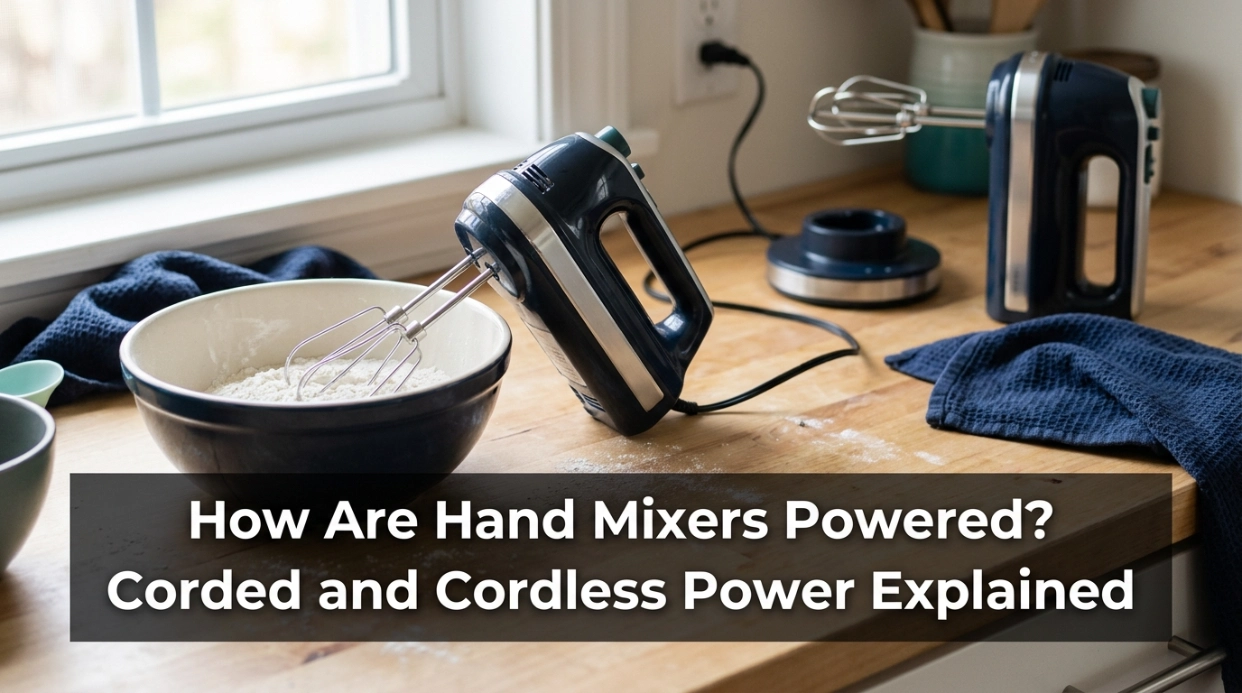
Most hand mixers are powered by electricity. Corded models draw electricity from a wall outlet, while cordless models store electrical energy in a rechargeable battery. In both designs, that electricity powers a motor that turns the beaters through internal gears and drive shafts. KitchenAid’s hand mixer use guide also describes the appliance as an electric handheld mixing tool.
How the power reaches the beaters
- Corded models: Electricity comes directly from a household outlet through the power cord.
- Cordless models: A rechargeable battery stores electricity until you switch the mixer on.
- Electric motor: Electrical energy is converted into mechanical rotation inside the mixer.
- Gear system: Gears transfer and control the motor’s rotation before it reaches the beaters.
- Speed control: The mixer changes motor output so the attachments can rotate slower or faster.
Simple rule to remember
- The outlet or battery supplies the energy; the motor and gears turn that energy into beater movement.
If you’re wondering, how are hand mixers powered, the answer involves more than simply saying “electricity.” The power source, motor, gears, speed control, and attachments all work together.
I find it useful to separate electrical input from mechanical mixing power. Doing that makes wattage, cordless batteries, and mixer speed much easier to understand.
In This Guide
How Are Hand Mixers Powered?
A hand mixer converts electrical energy into mechanical motion. The electrical energy comes either continuously through a cord or from energy stored in a rechargeable battery.
The motor does not directly mix your cake batter. It creates rotation that the mixer’s drivetrain transfers to its removable attachments.
Definition: A hand mixer is a portable electric kitchen appliance that uses a motor and drivetrain to rotate removable beaters, whisks, or compatible attachments inside a mixing bowl.
Inside a typical hand mixer, several components form a simple power chain. Each part has a different job.
- Power source: Supplies electrical energy from an outlet or rechargeable battery.
- Switch and controls: Turn the mixer on and regulate speed.
- Motor: Converts electrical energy into rotation.
- Gear train: Transfers motor rotation to the attachment sockets.
- Drive shafts: Connect the gears to the removable attachments.
- Beaters or whisk: Transfer that rotation into the food.
The beater movement mixes ingredients, but it can also beat or aerate them. The final effect depends on the attachment, speed, food thickness, and how you move the mixer.
As of 2026, this same basic principle applies to both traditional corded mixers and rechargeable cordless designs.
How Does a Corded Hand Mixer Get Power?
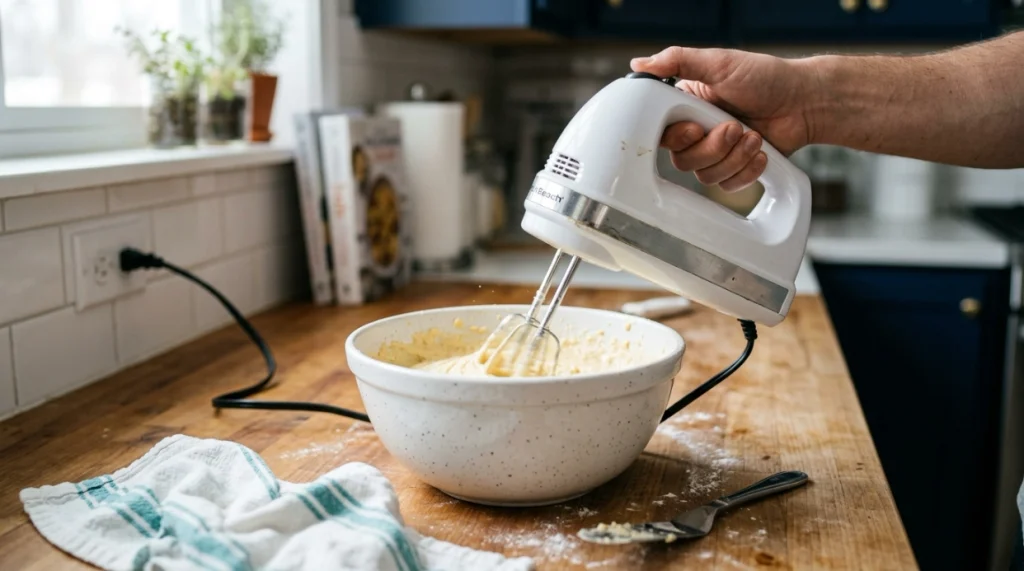
A corded hand mixer receives electricity directly from a household outlet. The power cord carries that electrical energy into the appliance whenever the mixer is plugged in and switched on.
The electricity then passes through the mixer’s internal electrical and control components. Its exact circuit design varies by manufacturer and model.
What happens after you switch it on?
The process happens almost instantly. You can think of it as a short chain of energy conversions.
- Electricity enters: Household electrical power reaches the mixer through its cord.
- The controls respond: The switch and speed-control system determine how the motor operates.
- The motor rotates: Electrical energy becomes mechanical rotation.
- Gears transfer motion: Internal gears send that movement to the beater sockets.
- The attachments spin: The beaters or whisk move through the ingredients.
It is important not to confuse the mixer’s electrical input with its motor construction. A corded appliance uses household mains power, but manufacturers can design the internal motor and control system in different ways.
That is why you cannot determine everything about a mixer simply by looking at its plug.
Why do corded mixers keep running consistently?
A corded model has continuous access to household electricity while plugged in. There is no battery gradually discharging during a mixing session.
This arrangement suits longer mixing tasks because you do not need to stop and recharge. Your recipe and the manufacturer’s recommended duty limits still matter.
Household appliance safety requirements cover hazards such as electrical, thermal, and mechanical risks. UL Solutions explains IEC 60335-1, the general safety standard used for household and similar electrical appliances.
How Do Cordless Hand Mixers Get Power?
A cordless hand mixer runs from a rechargeable battery instead of drawing power continuously through a cord. You charge the battery first, then the stored energy operates the mixer.
This removes the cord from your work area. It does not mean the appliance requires no electricity.
Where does a cordless mixer’s electricity come from?
The energy originally comes from a charging source. The charger transfers electrical energy into the mixer’s battery, where it is stored for later use.
- Charging stage: Electrical energy enters through the charging system.
- Storage stage: The rechargeable battery stores that energy.
- Operating stage: The battery supplies electricity to the motor and electronics.
- Mechanical stage: The motor and drivetrain rotate the attachments.
Many modern cordless appliances use rechargeable lithium-ion battery technology. The exact voltage, capacity, charging method, and battery chemistry should always be checked in the manufacturer’s specifications.
Does a cordless mixer lose power as the battery drains?
Battery state can affect usable runtime, although the behavior depends on the mixer’s electronics and battery-management system. Some designs regulate output so performance remains more consistent through much of the charge.
Eventually, the battery reaches its low-charge limit and requires recharging. This is the main practical difference from a corded mixer.
Battery-powered appliances also need suitable protection and control systems. UL discusses evolving safety requirements for battery-operated household appliances under IEC 60335-1.
Does Wattage Determine Hand Mixer Power?
Wattage is useful, but it does not tell you everything about mixing performance. Motor design, gears, speed control, attachment geometry, and efficiency can all affect how effectively a mixer handles ingredients.
This is one of the most common points of confusion when comparing hand mixers.
What does wattage mean?
A watt is a unit of power. On an electrical appliance, wattage helps describe the rate at which electrical energy is being used or rated.
KitchenAid’s hand mixer buying guide notes that hand mixer wattage can vary widely and also cautions that wattage alone does not describe total performance.
- Motor efficiency matters: Two motors can use electricity differently.
- Gear ratios matter: Gearing affects the relationship between rotation speed and usable torque.
- Speed control matters: Good low-speed control can be more useful than maximum speed for some recipes.
- Attachment design matters: Beaters and whisks interact with ingredients differently.
- Food resistance matters: Whipped cream puts a different load on a mixer than thick cookie dough.
Does more wattage always mean a stronger mixer?
No. A higher wattage rating should not automatically be treated as proof that one hand mixer will outperform another.
I treat wattage as one specification in the comparison, not as the final verdict. I also check speed range, attachment design, manufacturer limits, weight, control, and the types of mixtures the model is designed to handle.
A mixer that controls low speeds well can be easier to use when flour first enters wet ingredients. Raw electrical numbers cannot describe that handling difference by themselves.
Section Takeaway: Wattage describes electrical power, but useful mixing performance comes from the entire motor, control, gear, and attachment system.
Corded vs. Cordless Hand Mixer Power: What Is the Difference?
The main difference is where the operating electricity comes from. A corded hand mixer gets it continuously from an outlet, while a cordless hand mixer gets it from a charged battery.
Neither system is automatically better for every kitchen. Each changes how you use and position the appliance.
| Feature | Corded Hand Mixer | Cordless Hand Mixer |
|---|---|---|
| Operating power source | Household electrical outlet | Rechargeable battery |
| Needs charging | No | Yes |
| Needs outlet while mixing | Yes | No |
| Runtime limit | No battery runtime limit; follow manufacturer operating guidance | Limited by available battery charge and manufacturer guidance |
| Movement around kitchen | Restricted by cord length and outlet position | Not restricted by a power cord during operation |
| Internal energy conversion | Electricity powers a motor, which drives the attachments | Stored battery energy powers a motor, which drives the attachments |
When does corded power make sense?
- You’re often close to a convenient outlet.
- You don’t want to think about battery charge.
- You frequently make several recipes in one session.
- You prefer a straightforward plug-in appliance.
When does cordless power make sense?
- Your prep area has awkward outlet placement.
- You frequently move between work surfaces.
- You want to keep a power cord away from bowls and ingredients.
- You value portability more than unlimited plugged-in runtime.
The mixing principle remains almost identical after electricity reaches the motor. The biggest user-facing change is how that electricity gets there.
How Can You Use Hand Mixer Power Safely?
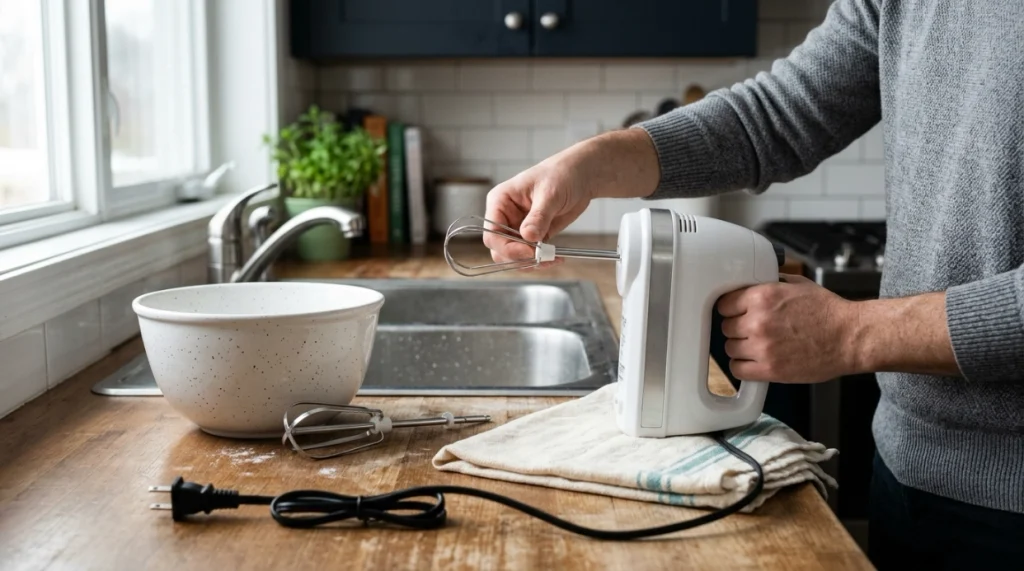
Electricity and moving attachments deserve basic precautions. Always follow the manual supplied with your exact hand mixer because controls and safety features vary.
For a corded mixer, check the cord and plug before use. Stop using the appliance if you notice damaged insulation, exposed conductors, overheating, unusual electrical smells, or repeated power interruptions.
- Keep it dry: Do not immerse the motor housing, cord, plug, charger, or unsuitable battery components in water.
- Unplug before handling beaters: Disconnect power before inserting, removing, or cleaning attachments unless the manufacturer explicitly specifies another safe procedure.
- Keep cords away from heat: Do not allow a cord to rest on a hot cooktop or other hot surface.
- Use the correct charger: Recharge cordless models only according to the manufacturer’s instructions.
- Stop after abnormal behavior: Smoke, sparking, repeated shutdowns, shock sensations, or severe overheating require attention.
The U.S. Consumer Product Safety Commission’s electrical safety guidance is a useful general reference for household electrical products.
Why won’t my hand mixer turn on?
Start with simple external checks. A corded model may have a loose plug, dead outlet, damaged cord, or incorrectly positioned control.
For cordless models, check charge level and confirm the battery or charging system is connected as the manufacturer specifies.
- Switch the mixer off.
- Check the outlet or battery charge.
- Inspect the accessible cord, plug, charger, and controls for obvious damage.
- Confirm the attachments are installed according to the manual.
- Check the manufacturer’s troubleshooting instructions.
- Stop using the mixer if there are signs of electrical or mechanical damage.
Pro tip: Do not open a sealed hand mixer or bypass a safety device to diagnose an electrical fault. Use the manufacturer’s service instructions or a qualified appliance repair technician instead.
Frequently Asked Questions About Hand Mixer Power
Are all hand mixers electric?
Modern appliances sold as hand mixers are generally electric motor-driven tools. Traditional manual egg beaters and whisks can perform similar tasks, but they use human effort rather than an electric motor.
Do hand mixers use batteries?
Cordless hand mixers use rechargeable batteries. Traditional corded hand mixers do not need a battery for normal operation because they receive electricity directly from a household outlet.
Do cordless hand mixers need to be plugged in?
Not while they are mixing, assuming the battery has enough charge. However, their battery must eventually be recharged using the charging system specified by the manufacturer.
Is a higher-watt hand mixer always more powerful?
No. Wattage is only one specification. Motor efficiency, gearing, control electronics, attachment design, speed range, and the load created by your ingredients all influence practical mixing performance.
Does a hand mixer use AC or DC power?
A corded mixer’s external supply normally comes from household mains electricity, while a battery stores and supplies direct-current electrical energy. The internal motor and electronic arrangement can vary, so check the manufacturer’s technical information for a specific model.
How does electricity make the beaters spin?
The mixer sends electrical energy to a motor, which converts that energy into rotational motion. Internal gears and drive components transfer the rotation to the attachment sockets and ultimately to the beaters.
Can I repair a hand mixer’s electrical system myself?
Simple external checks are reasonable, but internal electrical repairs can create shock, fire, and mechanical hazards. For internal faults, follow the manufacturer’s service guidance or use a qualified repair professional rather than bypassing protective components.
The simplest answer is this: corded hand mixers take electricity from an outlet, while cordless hand mixers take stored electricity from a rechargeable battery.
Both systems ultimately do the same job. They power a motor and drivetrain that rotate the attachments, turning electrical energy into the controlled mixing motion you use for batters, cream, eggs, frosting, and other foods.
When comparing mixers, don’t judge them by wattage alone. Look at the complete power system, speed control, attachments, intended workload, safety guidance, and whether corded or cordless operation better fits your kitchen.