The first time I looked at an egg cooker cup, the marks seemed backward. I expected six eggs to need more water than two. Yet many cookers show the opposite.
So, why do egg cookers need less water for more eggs? In many models, the water controls how long the steaming cycle lasts. More eggs change how heat and steam move inside the covered cooker, so less starting water can still give enough cooking time.
Think of the cup as a timer made of water. More water usually means a longer steam cycle.
Common Signs of the Problem
Most people notice the issue when the cup looks wrong or the eggs come out harder or softer than expected.
| Symptom | Likely Cause | Quick Fix |
|---|---|---|
| More eggs call for less water | Normal cooker calibration | Follow the cup |
| Eggs turn out too hard | Too much water | Use the correct lower line |
| Eggs stay too soft | Too little water | Add a small amount next time |
| Results keep changing | Wrong scale or mineral buildup | Check cup and plate |
I also learned not to guess if the original cup is lost. A small water change can affect the run time on a compact cooker.
If the markings are worn off, a replacement measuring cup can help. Try to get one made for the same model, since the lines may be calibrated for that cooker.
Possible Causes
The main cause is often not a fault. It is simply how the cooker is designed.
Water sits on the heating plate and turns to steam. The eggs absorb heat, while steam cools and forms drops on the eggs and lid. Some moisture then returns to the base.
With more eggs inside, the heat and steam pattern changes. This can make a smaller starting amount of water last long enough to reach the right level of doneness.
The goal is not to give each egg its own share of water. The goal is to keep the full cooking cycle near the right length.
Other things can change the result:
- Large eggs may need a little more cooking.
- Very cold eggs may cook more slowly.
- Hard eggs need a longer cycle than soft eggs.
- Mineral scale can affect heating.
- A badly seated lid can lose extra steam.
- A blocked steam vent is unsafe.
The cup may combine egg count and doneness in one scale. It is easy to read the hard-boiled marks while aiming for softer eggs.
How to Fix Water Issues: Why Do Egg Cookers Need Less Water for More Eggs?
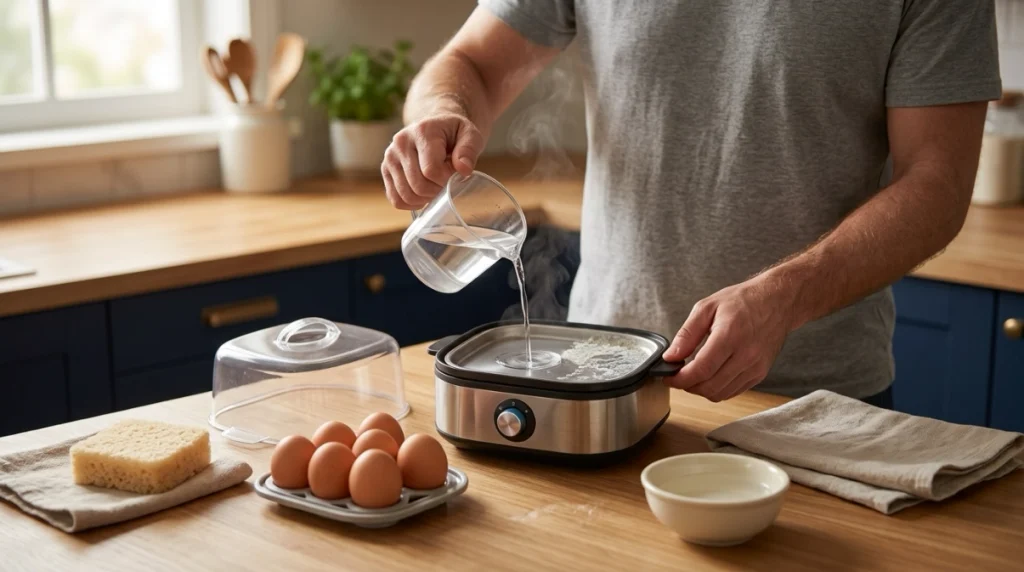
If the eggs cook well when you follow the cup, there may be nothing to fix. The lower water line can be normal.
If the results are poor, check these simple points.
Check the Water Measuring Cup
Use the line for both the egg count and the doneness you want. Do not fill to the top just because the tray is full.
Set the cup on a flat counter and read it at eye level. If the original cup is missing, check the manual before using a random cup.
Inspect the Egg Tray and Lid
Make sure the egg tray sits flat and the lid is in its normal position. A poor fit can let extra steam escape.
Never cover the steam vent with a towel, weight, or seal. Steam needs the path the maker designed.
Check the Heating Plate for Scale
A white or brown film is often mineral buildup. It can make heating less even.
For cleaning, I unplug the cooker and let it cool first. I then use the maker-approved method, often diluted white vinegar with a soft cloth or non-abrasive sponge.
Never immerse the powered base in water. Do not scrape a coated plate with a knife or metal pad.
Run a Simple Water Test
Use eggs of the same size and starting temperature. Follow the exact marked water line and note the result.
If the yolks are too firm, use a little less water next time. If they are too soft, use a little more. Change only one thing at a time.
Watch the Normal Shutoff Cycle
Many simple egg cookers use the water level and a heat sensor to control the end of the cooking cycle. Some beep when done, while others switch off.
If the cooker keeps heating with no water left, smells burnt, or fails to shut off, unplug it. Do not try to solve that by adding extra water.
| Problem | Recommended Solution | Difficulty |
|---|---|---|
| Eggs too hard | Reduce water slightly | Easy |
| Eggs too soft | Increase water slightly | Easy |
| Scale on plate | Descale after cooling | Easy |
| Damaged lid leaks steam | Replace lid if available | Easy |
| Unit will not shut off | Stop using it | Do not DIY |
Mistakes to Avoid
The biggest mistake is thinking more eggs must always need more water. In a calibrated egg cooker, water often acts as the cook-time control.
Do not mix the soft, medium, and hard scales. Some cups have several tiny rows, so it is easy to choose the wrong one.
Do not block the steam vent or force the lid closed. Hot steam can burn skin fast.
Do not touch the heating plate right after the alarm. It may be dry and still be very hot.
Never open the electrical base to change a thermostat, sensor, or safety switch. Do not bypass auto shut-off or overheat protection.
When to Replace the Egg Cooker
One bad batch is not a reason to replace the unit. First check the cup, water amount, scale buildup, tray, and lid.
Replacement makes sense if the cord is damaged, the base shows heat damage, there is a strong burning smell, or the unit no longer shuts off as designed.
A cracked lid, lost cup, or damaged egg tray may be replaceable by itself. Use a part that fits the exact model.
For a low-cost cooker with an internal electrical fault, replacement is usually safer than opening the sealed heating unit.
My Personal Experience
The cup was the confusing part for me. My first instinct was to add extra water for a bigger batch because that feels natural when cooking in a pot.
In my test, I kept the egg size and starting temperature the same. I followed the cup for a small batch, then used the lower line shown for a fuller tray.
The larger batch did not need a larger pool of water. When I added more water than the mark, the cooker ran longer and the yolks came out firmer.
My best lesson was to change one thing at a time. If results drift, I check the cup line, the plate for scale, and the lid before changing the water.
I now treat the printed mark as a starting point. I only make a tiny change if my egg size, fridge temperature, or preferred doneness calls for it.
Final Thoughts
Why do egg cookers need less water for more eggs? Because many models use water to control the steam cycle, and a fuller cooker changes how heat and steam are absorbed and cooled.
The lower water line is usually intentional. Follow the measuring cup made for your model first, then adjust only a little if your eggs come out too soft or too firm.
If the cooker overheats, smells burnt, has a damaged cord, or fails to shut off, stop testing water amounts. Unplug it and replace or professionally service the unit instead.
1 thought on “Why Do Egg Cookers Need Less Water for More Eggs? Smart Fix”