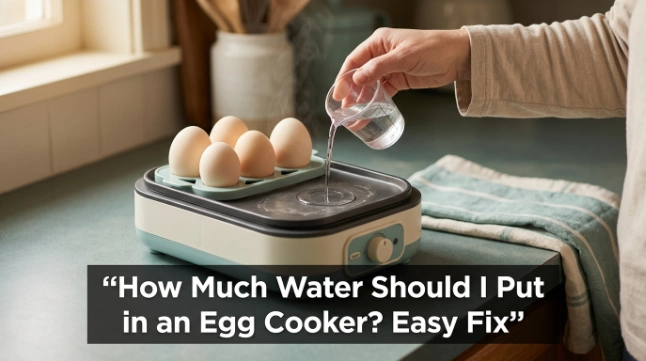
If you are asking, “how much water should I put in an egg cooker,” the safest answer is to use the marked measuring cup that came with your unit. Fill it to the line for soft, medium, or hard eggs.
The exact amount can range from about 20 to 60 milliliters. Yet it depends on the cooker, egg count, and desired result. Some models even use less water when cooking more eggs.
I learned this after several poor batches. My eggs came out too soft one day and dry the next. I first blamed the cooker, but my water level was the real issue.
In this guide, I will explain how to find the right amount. I will also share the simple tests that helped me get steady results.
Common Signs of the Problem
An egg cooker uses steam to cook eggs. The heating plate boils the water, and the lid holds the steam around the egg tray.
Too much or too little water changes the cooking time. It may also affect the texture of the yolk and white.
Here are some signs that the water amount is wrong:
- The egg white is still wet or clear.
- A “hard-boiled” yolk is soft in the middle.
- Soft eggs become firm or dry.
- Water remains on the heating plate.
- The cooker shuts off too soon.
- Steam or water leaks from the lid.
- Eggs crack while cooking.
- A dry plate gives off a hot smell.
This table can help you spot the cause fast.
| Symptom | Likely cause | Quick fix |
|---|---|---|
| Eggs are undercooked | Too little water | Add a small amount next time |
| Eggs are too firm | Too much water | Use slightly less water |
| Water remains after cooking | Overfilled plate | Follow the cup line |
| Steam escapes at the side | Lid or tray is not seated | Refit the tray and lid |
| Results change each time | Water was guessed | Use the same marked cup |
When I lost my original cup, I tried using a kitchen spoon. My results changed from batch to batch because I did not level each spoon well.
A replacement measuring cup was the most useful fix. If you buy one, choose a cup with milliliter marks. You can then record the exact amount that works in your cooker.
Possible Causes
The wrong water level is the most common cause of poor results. However, it is not the only one.
These are the causes I check first:
- The wrong line on the measuring cup was used.
- The cup markings were read from the wrong side.
- The amount was meant for a different egg count.
- The eggs were much larger or colder than usual.
- The egg tray was not sitting flat.
- The lid or steam vent was blocked.
- Mineral scale reduced heat flow.
- Water leaked before it could turn into steam.
- The cooker was stopped before auto shut-off.
Room-temperature eggs may cook a little faster than cold eggs. Large eggs may also need a bit more steam than small ones.
High altitude can affect cooking too. Water boils at a lower heat in high places, so the eggs may need a little more water and time.
The brand and model matter most. One cooker may need 30 milliliters for hard eggs, while another may need 50 milliliters.
That is why I do not treat one online chart as a rule for every machine. The manual and the original measuring cup should come first.
How Much Water Should I Put in an Egg Cooker?
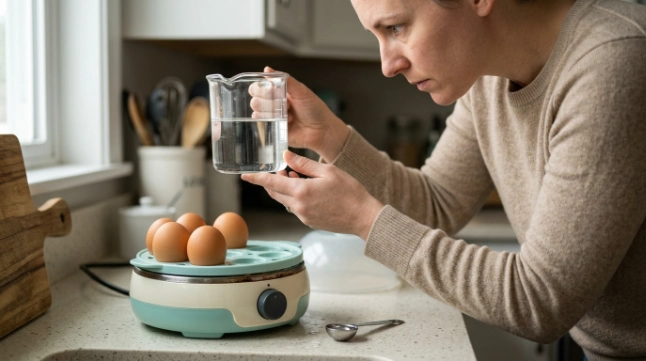
Start with the line printed on your egg cooker’s measuring cup. Select the line for the egg texture you want and the number of eggs being cooked.
If you do not have the cup or manual, start with a small test batch. Use about 30 milliliters of water for two to four medium eggs, then adjust in 5-milliliter steps.
This is only a starting point. Never exceed the maximum fill level shown by the maker.
Check the Water Measuring Cup
Place the cup on a flat counter. Bring your eyes down to the level of the water mark before reading it.
Some cups have different scales on each side. One side may show soft eggs, while the other shows medium and hard eggs.
I once filled my cup to the “4” mark without checking the label. That mark was for four soft eggs, not four hard eggs. The yolks were still runny.
Check both the egg count and the texture label. Do not assume that the highest line always means hard-boiled eggs.
Use the Manual as Your Main Guide
Look for a chart in the manual. It may list water levels by egg count and cooking style.
If you no longer have the paper copy, search for the exact model number. The model number is often printed under the cooker.
Do not use instructions for a similar-looking model. Heating plates can have different power levels, even when the cookers look alike.
Adjust for Soft, Medium, or Hard Eggs
As a general rule, more water creates more steam time. That often produces firmer eggs.
| Egg result | Water approach | Test adjustment |
|---|---|---|
| Soft yolk | Use the soft mark | Reduce by 5 ml if too firm |
| Medium yolk | Use the medium mark | Adjust by 5 ml |
| Hard yolk | Use the hard mark | Add 5 ml if the center is soft |
Some cookers work in the opposite way because their cup scale also accounts for the number of eggs. Always follow your model’s labels instead of guessing.
Test one setting at a time. Changing the water amount, egg size, and egg count together makes it hard to know what helped.
Check the Egg Tray and Lid
Set the egg tray flat over the heating plate. A tilted tray may let steam escape unevenly.
Place the lid on top without forcing it. Make sure the steam vent is open and facing away from your hands.
Do not cover the vent. Steam must leave through the path made by the maker.
If the lid is cracked, replace it with a part made for your model. A poor-fitting lid can release too much steam and leave the eggs undercooked.
Remove Mineral Buildup
White or brown marks on the heating plate are often mineral deposits. This scale can slow heat flow and cause uneven boiling.
Let the cooker cool and unplug it. For cleaning, wipe the plate with a soft cloth and the method given in the manual.
Many models can be descaled with a little white vinegar and water. Leave it briefly, then wipe it away with a damp, non-abrasive sponge.
Never pour water into the electrical base. Do not use steel wool or a sharp tool, as these can damage the plate.
Test the Auto Shut-Off
The auto shut-off often works when the water has boiled away. If you add too little water, the cooker may stop before the eggs are done.
If it keeps heating after the plate is dry, unplug it at once. Let it cool on a safe surface.
Do not bypass the safety switch or overheat protection. A cooker that will not shut off safely should be replaced.
Mistakes to Avoid
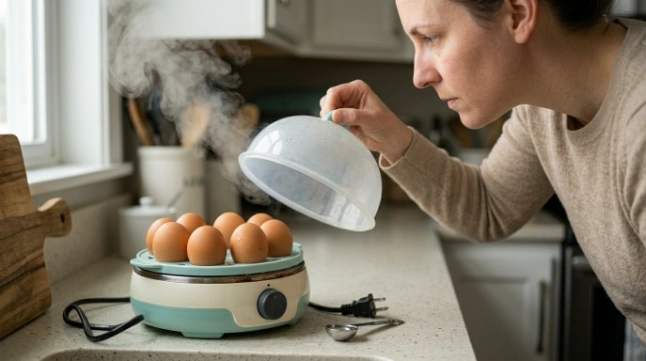
Do not pour water into the cooker while it is plugged in. Water near the cord, buttons, or electrical base can cause shock or damage.
Avoid these common mistakes:
- Guessing the amount without measuring
- Filling above the maximum line
- Using a cup from another model
- Blocking the lid’s steam vent
- Touching the hot lid or heating plate
- Running the cooker with no water
- Cleaning the base under running water
- Opening a sealed heating unit
- Bypassing the auto shut-off
I also avoid lifting the lid as soon as the alarm sounds. Hot steam can burn the face and hands.
Unplug the cooker first. Use the lid handle, tilt the lid away from you, and let the steam escape.
Do not attempt electrical repairs inside the base. If the cord is split, the control panel flashes, or there is a burning smell, stop using the cooker.
Water Problems and Simple Solutions
| Problem | Recommended solution | Difficulty |
|---|---|---|
| Lost measuring cup | Use a marked milliliter cup | Easy |
| Eggs are too soft | Add 5 ml next time | Easy |
| Eggs are too hard | Reduce water by 5 ml | Easy |
| Scale on heating plate | Descale after cooling | Easy |
| Cracked lid | Fit a model-specific lid | Easy |
| Cooker will not shut off | Stop use and replace it | Do not repair |
Keep brief notes during your tests. Record the egg count, egg size, water amount, and final texture.
This may feel excessive, but I only needed three batches to find my best setting. After that, I could repeat it without guessing.
When to Replace the Egg Cooker
A wrong water amount does not mean the cooker is broken. Most texture problems can be fixed with careful measuring or descaling.
Replacement makes more sense if you notice:
- A damaged power cord
- A loose electrical connection
- Smoke or a strong burning smell
- A heating plate that stays cold
- Failure of the auto shut-off
- Cracks in the electrical base
- Water leaking into the control area
- Repeated error lights after safe cleaning
A replacement cup, tray, or lid can be worth buying if the cooker still heats well. Make sure the part fits the exact brand and model.
Replace the full unit if the electrical base is damaged. Opening the base may expose live parts and is not a safe home repair.
My Personal Experience
My first test used four cold, large eggs. I guessed the water and poured in far too much. The cooker ran longer than expected, and the yolks became dry.
For the next batch, I found the correct hard-egg line on the cup. The eggs were better, but one yolk was still a little soft.
I added 5 milliliters for my third test. I kept the same egg size and count. That small change gave me firm whites and fully cooked yolks.
I later found scale on the plate. After I removed it, the cooker heated more evenly and needed slightly less water.
The biggest lesson was simple: small changes matter. I now use the same cup, water level, egg size, and tray position each time.
Final Thoughts
So, how much water should I put in an egg cooker? Use the marked cup and follow the line for your egg count and desired texture.
If the cup is missing, start near 30 milliliters for a small batch. Adjust by only 5 milliliters at a time and keep notes.
Check the tray, lid, vent, and heating plate if the result is still poor. Never open the electrical base or bypass a safety feature.
Once you find the right level for your cooker, repeat it each time. That simple habit gave me far more reliable eggs than guessing ever did.
4 thoughts on “How Much Water Should I Put in an Egg Cooker? Easy Fix”